
MB-335 · Question #36
Case Study 5 - ADatum Corporatio Background ADatum Corporation is a golf cart manufacturing and rental company. The company produces golf carts, converts them to assets, and then rents them out over…
Sign in or unlock MB-335 to reveal the answer and full explanation for question #36. The question stem and answer options stay visible for context.
Question
Case Study 5 - ADatum Corporatio Background ADatum Corporation is a golf cart manufacturing and rental company. The company produces golf carts, converts them to assets, and then rents them out over a period of time. The engineering team continuously seeks to create innovative, sustainable golf carts to stay current in the industry. Although the company no longer creates gas-powered vehicles, some of its models are still in use as rentals. ADatum Corporation plans to move from multiple, disconnected systems for each team of employees to a connected platform that uses Dynamics 365 Finance and Dynamics 365 Supply Chain Management. Current Environment Employee teams
- ADatum Corporation has four key teams of employees:
o Procurement: A team of buyers who source raw materials for the production of the golf carts o Engineering: A team of engineering designers who continuously modify and improve the bill of materials (BOM) for the golf carts o Production: A team of production employees, including quality assurance (QA), who manages the BOM costs and work on the shop floor to produce the golf carts o Asset Management: A team that manages the golf cart assets, including maintenance and repairs
- The company has strict controls and uses engineering change management within its end-to-
end operations. Golf cart models
- All new golf carts are rechargeable electric models.
- The company has three primary golf cart models:
o ModelA is manufactured for commercial customers, such as golf courses. Those golf courses rent ModelA for a fixed period of time. o ModelA contains subassemblies that are produced by ADatum Corporation and stored in the warehouse until required for production. o ModelB is manufactured for consumers and can be rented by vacationers, typically for a weekend. o ModelB must include turn signals and brake lights to ensure that it is legal to drive on city streets. o ModelB golf carts are typically stored in a rented parking lot during peak vacation season. o During the off-season, ModelB is stored in ADatum Corporation's headquarters warehouse. o ModelT units are gas-powered units that have been discontinued for production; however, existing assets are available for rent.
- All models are considered low-speed vehicles and must not exceed 25 mph.
- All golf cart models are owned by ADatum Corporation. None are owned by commercial
customers. Requirements Engineering
- The engineering manager plans to phase out production of the current steel frames and replace
them with aluminum frames.
- Innovation engineers observe an increase in consumer requests for lifted-style golf carts.
ModelB will be used to create a prototype of a newer version. Production
- Golf cart frames for all models must be configured as subassemblies.
- The engineering team plans for the lift kit shocks and struts to be assembled for the prototype
as a single production order for the lift kit finished good. The lift kit will remain at the end of the assembly line for the prototype.
- The QA team must conduct a rigorous set of mandatory tests for the ModelB prototype. Only
certified QA team members can complete the checklists. The item will not be available for production until the prototype passes testing.
- The lithium batteries must be installed by a certified technician during production.
- The raw materials used in the prototype model are also sold directly as spare parts.
- The controller requires raw material consumption to be posted in the ledger separately for the
prototype production orders.
- The warehouse manager requires that ModelA subassemblies must have putaway work created
for the warehouse workers. All other subassemblies and finished goods will not require warehouse work. The lift kit subassembly must have a new standard cost created. o Cost Requirement 1: The costs for existing materials are frozen for a period. The incremental costs must be calculated without impacting current frozen costs. o Cost Requirement 2: The incremental cost for the subassembly must be determined based on the raw material purchased parts before it is available as a price. Asset management
- All electric models can be serviced on a quarterly schedule, which is less frequent than the
bimonthly gas-powered models.
- The controller requires ModelB to be reported separately from other models, and the location of
the assets updated at each peak travel season.
- Maintenance technicians run a lean schedule and are fully booked out in advance.
Issues Procurement
- Buyer1 reports that the master planning process generated planned purchase orders for steel
frame subassemblies. Return orders were created for the steel frames, which should not have been ordered. Production
- The production manager reports that the lithium battery installation step is creating a production
backup because of two issues:
o Issue 1: Technicians who are not certified are assigned to the battery installation step. o Issue 2: One certified technician is always on site at the production facility; the other certified technician is on call for repairs to rentals and is only substitutes for other technicians occasionally for production. Asset management
- A golf course manager reports that multiple ModelT units are frequently slow to start. The golf
course manager requests monthly inspections for ModelT units, but the ModelA units can keep their current schedule.
- After the ModelT unit issue was addressed, the golf course manager reports that one of the
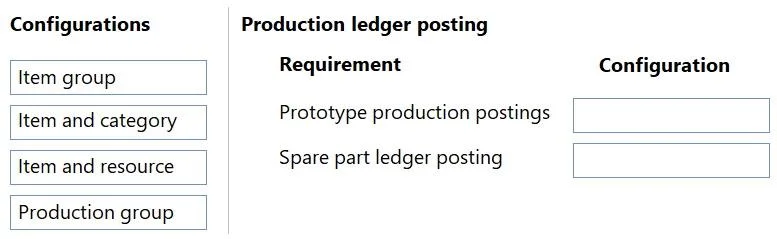
ModelA units stopped charging. The golf course manager requests a priority repair to be scheduled for the next morning. Drag and Drop Question You need to configure the production requirements of the controller. What should you configure? To answer, move the appropriate configurations to the correct requirements. You may use each configuration once, more than once, or not at all. You may need to move the split bar between panes or scroll to view content. NOTE: Each correct selection is worth one point. Answer:
Exhibit
Answer Area
Drag items
Unlock MB-335 to see the answer
You've previewed enough free MB-335 questions. Unlock MB-335 for full answers, explanations, the timed quiz mode, progress tracking, and the master PDF. Question stem and options stay visible so you can still see what's on the exam.