MB-335 · Question #188
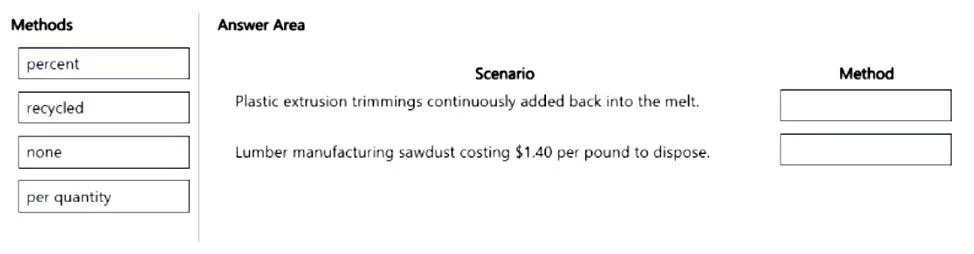
Drag and Drop Question A process manufacturing company is implementing Dynamics 365 Supply Chain Management. The company will use multiple process manufacturing functionalities including…
The correct answer is none; per quantity. By-Product Burden Allocation Methods in D365 Supply Chain Management > Note: The specific scenario descriptions are missing from your question, but the correct answers are none (scenario 1) and per quantity (scenario 2). Here's a full breakdown of all methods and the reasoning…
Question
Exhibit
Answer Area
Drag items
Correct arrangement
- none
- per quantity
Explanation
By-Product Burden Allocation Methods in D365 Supply Chain Management
Note: The specific scenario descriptions are missing from your question, but the correct answers are
none(scenario 1) andper quantity(scenario 2). Here's a full breakdown of all methods and the reasoning behind those placements.
The Four Allocation Methods
| Method | What It Does |
|---|---|
| none | By-product is tracked but carries zero cost burden - no financial impact on formula cost |
| per quantity | Cost burden scales linearly with quantity produced of the by-product |
| percent | A fixed percentage of total formula cost is allocated to the by-product |
| recycled | By-product is fed back into the process, reducing the formula's overall cost |
Why Each Answer Is Correct
Position 1 → none
Typical scenario: The by-product must be recorded for compliance or inventory tracking, but should not affect the cost of the main product.
Technical reason: Setting burden to none means the formula cost calculation ignores the by-product entirely. The system records the output without crediting or debiting any cost against the formula. This is appropriate when the by-product has negligible value or when cost neutrality is required.
Position 2 → per quantity
Typical scenario: The company wants to allocate a cost burden proportional to how much by-product is produced.
Technical reason: per quantity assigns a cost per unit of by-product output. As production volume increases, the burden increases proportionally. This is the standard method when the by-product has a consistent, measurable value relationship to its quantity.
Common Mistakes & Misconceptions
- Confusing
recycledwithnone:recycledactively reduces formula cost (the by-product re-enters the process as a material credit).nonesimply ignores cost - it does not reduce anything. - Using
percentwhen quantity is the driver:percentis for scenarios where the by-product should absorb a fixed share of total formula cost regardless of volume - not the same as scaling with quantity. - Assuming
nonemeans the by-product isn't tracked: It still appears in the formula and on production orders; only the financial burden is zero. - Overlooking that methods can repeat: The question states each method may be used more than once, so don't assume each scenario requires a unique method.
Topics
Community Discussion
No community discussion yet for this question.