MB-335 · Question #142
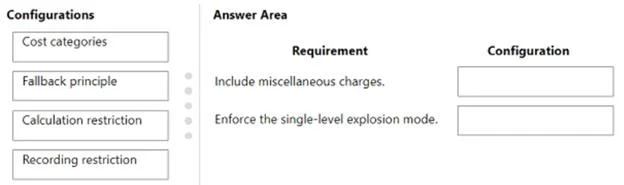
Drag and Drop Question A manufacturing company is implementing Dynamics 365 Supply Chain Management. Bill of materials (BOMs) must be calculated using standard cost principles. Miscellaneous charges m
The correct answer is Recording restriction; Calculation restriction. Dynamics 365 SCM - BOM Calculation Configuration Context This question is about configuring BOM Calculation Groups in D365 Supply Chain Management. The two drag targets correspond to two specific requirements, and you must match each to the correct configuration setting. --- Requ
Question
Exhibit
Answer Area
Drag items
Correct arrangement
- Recording restriction
- Calculation restriction
Explanation
Dynamics 365 SCM - BOM Calculation Configuration
Context
This question is about configuring BOM Calculation Groups in D365 Supply Chain Management. The two drag targets correspond to two specific requirements, and you must match each to the correct configuration setting.
Requirement 1 → Recording restriction
Requirement: Miscellaneous charges must be included in the unit cost price.
Why Recording restriction: The Recording restriction field on a BOM Calculation Group controls which cost components get recorded and reflected in the calculated unit cost. By configuring this setting to allow miscellaneous charges (surcharges/indirect cost components), the system ensures those charges are folded into the item's unit cost price - not just tracked separately. Without the correct recording restriction, miscellaneous charges may be calculated but not actually written into the unit cost.
Common mistake: Candidates often select Cost categories here. Cost categories define how cost components (labor, overhead, etc.) are classified, but they don't control whether miscellaneous charges are included in the unit cost price during calculation. That's the recording restriction's job.
Requirement 2 → Calculation restriction
Requirement: The explosion mode must always be enforced as single level.
Why Calculation restriction: The Calculation restriction setting governs how the BOM explosion behaves during cost calculation - specifically, it can enforce that the explosion always stops at the first level (single-level explosion) rather than recursively drilling into sub-BOMs. This ensures the system never overrides that mode at the individual calculation level, making it a system-enforced rule.
Common mistake: Candidates sometimes select Fallback principle here. The fallback principle handles what cost data to use when an active standard cost doesn't exist for a component - it's about missing data resolution, not about controlling explosion depth.
Why the other options are wrong
| Option | What it actually does |
|---|---|
| Cost categories | Classifies cost components (e.g., machine time, labor). Relevant to routing, not explosion mode or charge inclusion. |
| Fallback principle | Defines the backup cost source (e.g., use purchase price) when no standard cost is active. Not related to either requirement here. |
Key Takeaway
- Recording restriction = controls what gets written into the cost price (charges inclusion)
- Calculation restriction = controls how the BOM is processed (explosion mode enforcement)
Topics
Community Discussion
No community discussion yet for this question.