MB-230 · Question #54
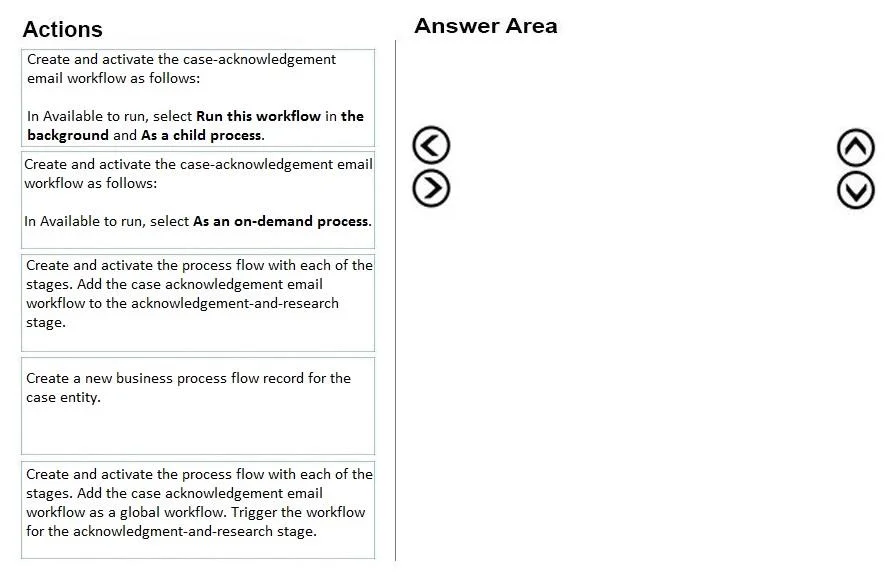
Drag and Drop Question You are a Dynamics 365 for Customer Service administrator. Your company requires a new phone-to-case business process flow for customer service representatives to follow. The st
The correct answer is Create a new business process flow record for the case entity.; Create and activate the case-acknowledgement email workflow as follows: In Available to run, select Run this workflow in the background and As a child process.; Create and activate the process flow with each of the stages. Add the case acknowledgement email workflow to the acknowledgement-and-research stage.. Dynamics 365: Phone-to-Case Business Process Flow - Explanation --- Why This Order? The three steps form a strict dependency chain: you can't configure what doesn't exist yet. Each step is a prerequisite for the next. --- Step-by-Step Breakdown Step 1: Create a new business proce
Question
Exhibit
Answer Area
Drag items
Correct arrangement
- Create a new business process flow record for the case entity.
- Create and activate the case-acknowledgement email workflow as follows: In Available to run, select Run this workflow in the background and As a child process.
- Create and activate the process flow with each of the stages. Add the case acknowledgement email workflow to the acknowledgement-and-research stage.
Explanation
Dynamics 365: Phone-to-Case Business Process Flow - Explanation
Why This Order?
The three steps form a strict dependency chain: you can't configure what doesn't exist yet. Each step is a prerequisite for the next.
Step-by-Step Breakdown
Step 1: Create a new business process flow record for the case entity.
This is the container. In D365, a Business Process Flow (BPF) is itself a process record tied to a specific entity (here: Case). You must create this record first before you can define stages, add steps, or reference any workflows. Nothing else in the chain is possible without this existing first.
Step 2: Create and activate the case-acknowledgement email workflow - with "Run this workflow in the background" AND "As a child process."
Two settings matter here, and both are required:
- "Run this workflow in the background" - This makes it asynchronous. Email sending should not block the UI or require user interaction; background execution is appropriate.
- "As a child process" - This is the critical one. When a workflow needs to be called by another process (specifically, triggered by a BPF stage transition), it must be designated a child process. Without this flag, the BPF cannot invoke it as a stage step. The workflow must be created and activated before Step 3, because Step 3 references it by name.
Step 3: Create and activate the process flow with all three stages. Add the case-acknowledgement email workflow to the acknowledgement-and-research stage.
Now that the BPF record exists (Step 1) and the workflow is ready as a child process (Step 2), you can fully build out the BPF: define the Verification, Acknowledgement and Research, and Resolution stages, then attach the email workflow as a step inside the acknowledgement-and-research stage. Activating the BPF makes it available to reps.
Why the Rejected Items Are Wrong
| Rejected Item | Why It's Wrong |
|---|---|
| "As an on-demand process" | On-demand workflows require a user to manually trigger them. The requirement is automatic email on stage entry - this defeats the automation. |
| "Add as a global workflow; trigger for the stage" | Global workflows fire on entity record events (create, update, field change), not on BPF stage transitions. You cannot reliably fire a global workflow specifically when a stage is entered this way. The correct pattern is attaching it directly as a step within the stage. |
Common Mistakes
- Skipping Step 1 - Candidates sometimes jump to building stages without realizing the BPF itself is a record that must be created first.
- Choosing "on-demand" over "child process" - These sound similar but behave completely differently. On-demand = user clicks a button. Child process = another process calls it programmatically.
- Using a global workflow - This is a tempting distraction because global workflows can send emails, but they can't be scoped to a BPF stage entrance reliably. Stage-level workflow steps are the correct mechanism.
- Building the BPF before the workflow exists - You must reference the workflow when configuring the stage step, so the workflow must be activated first.
Topics
Community Discussion
No community discussion yet for this question.