nerdexam
Microsoft

MB-230 · Question #166

Drag and Drop Question You are creating agent scripts in Dynamics 365 Customer Service. You must add the following steps to the scripts: 1. Use the greeting: Welcome to the company, how may we serve…

The correct answer is Text instructions; Macro; Agent script. Dynamics 365 Agent Script Step Types - Explained Understanding the Three Step Types | Type | Purpose | |---|---| | Text instructions | Displays static text for the agent to read - no automation | | Macro | Executes a series of automated actions with a single click | | Agent…

Configure representative experience and routing

Question

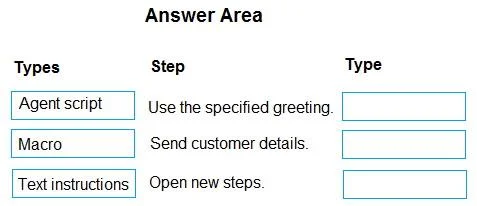
Drag and Drop Question You are creating agent scripts in Dynamics 365 Customer Service. You must add the following steps to the scripts: 1. Use the greeting: Welcome to the company, how may we serve you today? 2. Send details about a customer's account to the customer with one selection. 3. Open another set of steps to follow. You need to configure the type of steps that are needed. Which type should you choose when configuring each step? To answer, drag the appropriate types to the correct steps. Each type may be used once, more than once, or not at all. You may need to drag the split bar between panes or scroll to view content. NOTE: Each correct selection is worth one point. Answer:

Exhibit
MB-230 question #166 exhibit

Answer Area

Drag items

Agent scriptMacroText instructions

Correct arrangement

  • Text instructions
  • Macro
  • Agent script

Explanation

Dynamics 365 Agent Script Step Types - Explained

Understanding the Three Step Types

TypePurpose
Text instructionsDisplays static text for the agent to read - no automation
MacroExecutes a series of automated actions with a single click
Agent scriptLaunches another nested/sub-script (a new set of steps)

Step-by-Step Placements

Step 1 → Text instructions "Welcome to the company, how may we serve you today?"

This is a greeting the agent reads aloud - it's purely informational text. Text instructions are designed exactly for this: showing a static message to guide the agent's speech or behavior. No automation is triggered; the agent simply reads and follows the displayed text.

Common mistake: Choosing "Macro" here. Macros perform automated system actions; they can't display a spoken greeting.


Step 2 → Macro "Send details about a customer's account to the customer with one selection"

The key phrase is "with one selection." Macros execute multiple background actions (e.g., fetching account data, composing a message, sending it) as a single automated sequence triggered by one click. This is precisely what macros are built for - reducing multi-step actions to one.

Common mistake: Choosing "Agent script" here. A nested script opens more steps to follow manually; it doesn't automate sending data in one action.


Step 3 → Agent script "Open another set of steps to follow"

The phrase "another set of steps" is the tell. An Agent script step type references and launches a separate, nested agent script - effectively branching the workflow into a new sequence. This is the only type that opens a new script context.

Common mistake: Choosing "Text instructions" here. Text instructions only render static text - they cannot navigate to or load a different script.


Quick Summary Rule

  • Read something? → Text instructions
  • Do something automatically in one click? → Macro
  • Go somewhere (open new steps)? → Agent script

Topics

#agent scripts#macro steps#text instructions#productivity tools

Community Discussion

No community discussion yet for this question.

Full MB-230 Practice