
352-001 · Question #658
Refer to the exhibit. You designed an IPv6 migration plan, and now you need to determine the impact on the existing IPv4 network. Assume default IS-IS parameters. What is likely to happen when you…
The correct answer is D. Loopback reachability between all routers for IPv4 is lost. In default IS-IS single-topology mode, enabling IPv6 on only one side of a link causes a topology mismatch that disrupts the shared SPF tree, breaking IPv4 loopback reachability across the domain.
Question
Refer to the exhibit. You designed an IPv6 migration plan, and now you need to determine the impact on the existing IPv4 network. Assume default IS-IS parameters. What is likely to happen when you enable IPv6 routing on the link between R3 and R2, starting at R3?
Exhibit
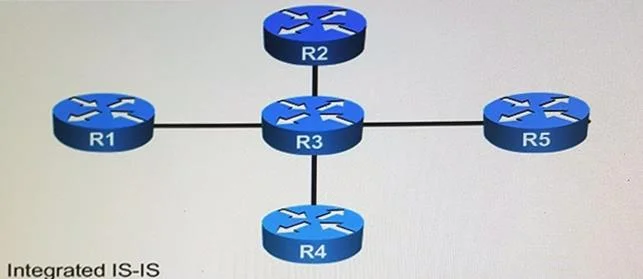
Options
- AOnly R3 and R2 have IPv4 and IPv6 reachability
- BR3 advertises the link from R3-R2 to R1, R4 and R5 only
- CAll routers except R2 are reachable through IPv4
- DLoopback reachability between all routers for IPv4 is lost
- ER2 receives an Ipv6 default routefrom R3.
How the community answered
(33 responses)- A9% (3)
- B27% (9)
- C15% (5)
- D45% (15)
- E3% (1)
Why each option
In default IS-IS single-topology mode, enabling IPv6 on only one side of a link causes a topology mismatch that disrupts the shared SPF tree, breaking IPv4 loopback reachability across the domain.
R2 has no IPv6 enabled on the link so IPv6 reachability does not apply to R2, and the single-topology SPF disruption affects IPv4 paths across all routers, not just the R3-R2 pair.
IS-IS floods LSPs to all neighbors through its flooding mechanism and cannot selectively advertise to only a subset of routers such as R1, R4, and R5.
The topology disruption caused by the single-topology mismatch breaks paths both to and through R2, meaning reachability loss is not limited to R2 alone but affects all routers relying on that link.
IS-IS default behavior is single-topology mode, meaning IPv4 and IPv6 share a single SPF tree and link-state database. When R3 enables IPv6 on the R3-R2 link, it begins advertising IPv6 TLVs in its LSPs, but R2 has not enabled IPv6 on its side. This creates a topology inconsistency in the single SPF tree that IS-IS cannot resolve, causing the link to be removed from the topology and breaking IPv4 loopback reachability for all routers that depended on that path.
IS-IS does not automatically generate or redistribute IPv6 default routes when IPv6 is enabled on an interface; no default IPv6 route would be sent from R3 to R2.
Concept tested: IS-IS single-topology IPv6 migration impact
Source: https://www.cisco.com/c/en/us/td/docs/ios-xml/ios/iproute_isis/configuration/xe-16/iri-xe-16-book/ip6-mt-isis.html
Topics
Community Discussion
No community discussion yet for this question.