
352-001 · Question #588
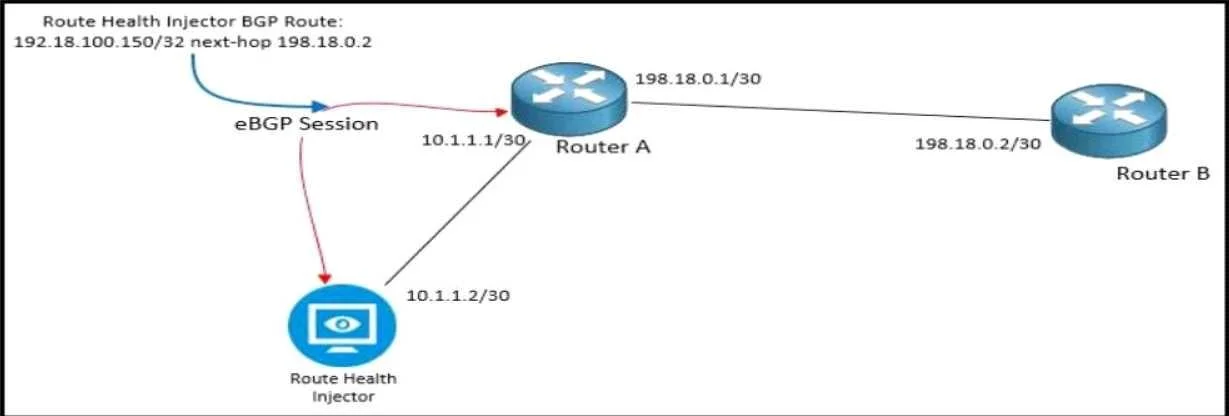
Refer to the exhibit. As part of your design to monitor reachable services, a route health injector has just been deployed on the network. The route health injector injects /32 host routes into BGP…
The correct answer is D. eBGP multihop attribute. eBGP multihop is required when an eBGP peer is not directly connected, as the default TTL of 1 prevents the BGP session from being established across multiple hops.
Question
Refer to the exhibit. As part of your design to monitor reachable services, a route health injector has just been deployed on the network. The route health injector injects /32 host routes into BGP with the next hop of 192.18.0.2, but the /32 routes are not being installed into the RIB or FIB of Router.. Which BGP feature must be deployed to make be deployed to make the design to work?
Exhibit
Options
- ABGP community attributes
- BMP-BGP
- CBGP AS-Path prepending
- DeBGP multihop attribute
How the community answered
(36 responses)- A8% (3)
- B6% (2)
- C3% (1)
- D83% (30)
Why each option
eBGP multihop is required when an eBGP peer is not directly connected, as the default TTL of 1 prevents the BGP session from being established across multiple hops.
BGP community attributes are used for tagging routes to apply routing policy and have no effect on whether a BGP session can be established with a non-directly-connected peer.
MP-BGP extends BGP to carry additional address families such as IPv6 or VPNv4 but does not resolve the connectivity issue caused by the default TTL restriction on eBGP sessions.
BGP AS-Path prepending artificially lengthens the AS path to influence inbound path selection from other ASes and has no bearing on route installation or eBGP session establishment.
By default, eBGP enforces a TTL of 1, requiring the peer to be on a directly connected network segment. When the route health injector with next hop 192.18.0.2 is not directly adjacent to the router, the eBGP multihop feature must be configured to increase the allowed TTL, permitting the BGP session to traverse multiple hops. Once the session is established with multihop enabled, the injected /32 host routes can be received and installed into the RIB and FIB.
Concept tested: eBGP multihop for non-directly-connected peers
Source: https://www.cisco.com/c/en/us/support/docs/ip/border-gateway-protocol-bgp/13751-23.html
Topics
Community Discussion
No community discussion yet for this question.