
352-001 · Question #587
Refer to the exhibit. Service provider ACME Internet just added a 100 GB/s peering in Paris that it wants to use by default for outbound traffic to Big ISP. Which routing policy achieves the desired…
The correct answer is A. Use traffic engineering by injecting a preferred LOCAL_PREF attribute to routes advertised from. BGP LOCAL_PREF is the correct attribute to influence outbound path preference within an AS, making the Paris peering the preferred exit for traffic to Big ISP.
Question
Refer to the exhibit. Service provider ACME Internet just added a 100 GB/s peering in Paris that it wants to use by default for outbound traffic to Big ISP. Which routing policy achieves the desired outcomes?
Exhibit
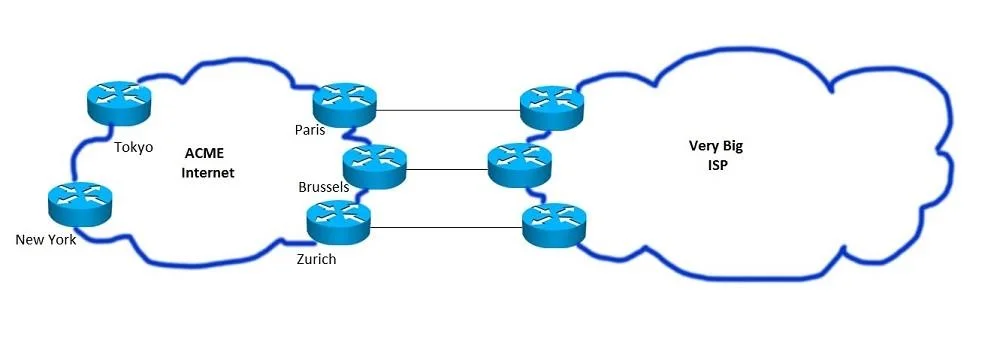
Options
- AUse traffic engineering by injecting a preferred LOCAL_PREF attribute to routes advertised from
- BApply an import policy in New York that adds a Weight attribute to routes learned from Very Big
- CApply an export policy in Paris by applying a MED or community attribute with a preference that
- DApply an import policy hat filters longer prefixes than /24 in Brussels and zurich
How the community answered
(20 responses)- A60% (12)
- B10% (2)
- C5% (1)
- D25% (5)
Why each option
BGP LOCAL_PREF is the correct attribute to influence outbound path preference within an AS, making the Paris peering the preferred exit for traffic to Big ISP.
LOCAL_PREF is an iBGP attribute used to influence outbound traffic selection within an autonomous system - higher LOCAL_PREF values are preferred over lower ones. By setting a higher LOCAL_PREF on routes learned via the new Paris peering, all iBGP routers in ACME's network will consistently prefer the Paris exit point for traffic destined to Big ISP. This is the standard BGP mechanism for controlling outbound traffic policy across multiple exit points within a single AS.
Weight is a Cisco-proprietary attribute that is local to a single router and is not propagated via iBGP, so it cannot coordinate outbound path preference across the entire ACME network.
MED (Multi-Exit Discriminator) is advertised to neighboring ASes to influence how they send inbound traffic into your AS, not a mechanism to control your own outbound traffic preference.
Filtering prefixes longer than /24 in Brussels and Zurich would limit reachability by discarding more-specific routes but would not establish a preference for the Paris peering for outbound traffic.
Concept tested: BGP LOCAL_PREF for outbound path preference
Source: https://www.cisco.com/c/en/us/support/docs/ip/border-gateway-protocol-bgp/13753-25.html
Topics
Community Discussion
No community discussion yet for this question.