
352-001 · Question #27
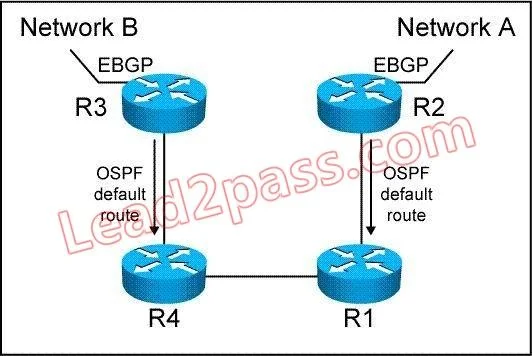
Refer to the exhibit. R2 and R3 are running EBGP and are learning Network A and Network B. R2 and R3 are also running IBGP to exchange Network A and Network B. OSPF is IGP. R2 and R3 are advertising…
The correct answer is A. create a tunnel between R2 and R3. A tunnel between R2 and R3 resolves the IBGP next-hop reachability problem that prevents traffic from Network A from reaching Network B across the two BGP border routers.
Question
Refer to the exhibit. R2 and R3 are running EBGP and are learning Network A and Network B. R2 and R3 are also running IBGP to exchange Network A and Network B. OSPF is IGP. R2 and R3 are advertising default routes. R1 and R4 can send and receive traffic from Network A and Network B respectively. However, Network A cannot send traffic to Network B. How can you solve this problem?
Exhibit
Options
- Acreate a tunnel between R2 and R3
- Bcreate a tunnel between R2 and R4
- Ccreate static default routes pointing from R1 and R4 to R2 and R3, respectively
- Dconvert R3 and R2 to ABRs so that R1 and R4 can choose the closest ABR to exit the network
How the community answered
(27 responses)- A67% (18)
- B4% (1)
- C11% (3)
- D19% (5)
Why each option
A tunnel between R2 and R3 resolves the IBGP next-hop reachability problem that prevents traffic from Network A from reaching Network B across the two BGP border routers.
In IBGP, routes are advertised with the original EBGP next-hop address unchanged (next-hop-self is not applied by default), meaning R2 must have an IGP-reachable path to R3's EBGP peer address to forward traffic toward Network B, and vice versa. A GRE or MPLS tunnel between R2 and R3 provides a routable path that resolves next-hop reachability and enables transit forwarding between the two EBGP boundary routers.
A tunnel between R2 and R4 bypasses R3 entirely and does not address the IBGP next-hop reachability issue between R2 and R3 that blocks Network A-to-Network B traffic.
Static default routes from R1 and R4 pointing to R2 and R3 only affect how R1 and R4 reach their local exit points and do not resolve the forwarding failure between R2 and R3.
Converting R2 and R3 to OSPF ABRs is an IGP concept unrelated to BGP next-hop reachability and would not fix the inter-domain forwarding path between the two EBGP border routers.
Concept tested: IBGP next-hop reachability and GRE tunnel as solution
Source: https://www.cisco.com/c/en/us/support/docs/ip/border-gateway-protocol-bgp/13753-25.html
Topics
Community Discussion
No community discussion yet for this question.