
352-001 · Question #186
Refer to the exhibit. The routers in this network are all running EIGRP. What is the most important step to take in order to ensure that this network core will converge quickly should a link failure…
The correct answer is B. make certain EIGRP is not running across non-transit links. EIGRP convergence in a core network is improved by not running EIGRP on non-transit links, which bounds query propagation and prevents the stuck-in-active condition.
Question
Refer to the exhibit. The routers in this network are all running EIGRP. What is the most important step to take in order to ensure that this network core will converge quickly should a link failure occur?
Exhibit
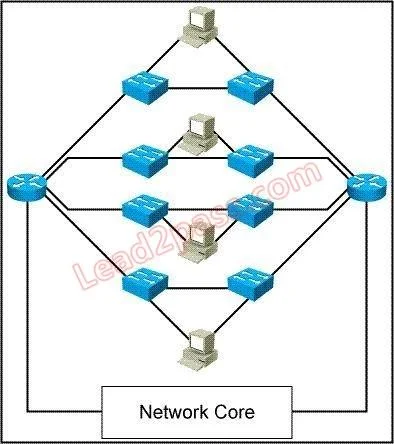
Options
- Amake certain EIGRP is running across all links
- Bmake certain EIGRP is not running across non-transit links
- Cmake certain the maximum number of paths on both of the routers is two
- Dadd another link between the two routers with no servers and set the metric on this new link equal
How the community answered
(22 responses)- A9% (2)
- B73% (16)
- C14% (3)
- D5% (1)
Why each option
EIGRP convergence in a core network is improved by not running EIGRP on non-transit links, which bounds query propagation and prevents the stuck-in-active condition.
Running EIGRP across all links, including non-transit ones, extends query propagation into stub segments and increases the number of outstanding replies routers must wait for, worsening convergence time.
Running EIGRP only on transit links prevents DUAL query messages from propagating into non-transit segments such as server-facing links, so routers do not wait for replies from stub neighbors before completing re-computation. Without those pending replies, the stuck-in-active condition is avoided and the network reconverges quickly after a link failure. This is the same principle underlying EIGRP stub routing, where bounding query scope is the primary mechanism for fast core convergence.
Setting the maximum number of ECMP paths to two is a load-balancing parameter and has no direct effect on how quickly DUAL reconverges after a link failure.
Adding a parallel link with an equal metric improves redundancy and load balancing but does not limit query propagation, which is the root cause of slow convergence.
Concept tested: EIGRP stub routing and query scope reduction
Source: https://www.cisco.com/c/en/us/td/docs/ios-xml/ios/iproute_eigrp/configuration/xe-16/ire-xe-16-book/ire-stub-rtg.html
Topics
Community Discussion
No community discussion yet for this question.