
352-001 · Question #171
Refer to the exhibit. In this network design, where should summarization occur to provide the best summarization and optimal paths during a single-failure incident as well as during normal operation?
The correct answer is C. a single identical summary on 3A and 3B. Placing a single identical summary on 3A and 3B - the highest aggregation tier - provides the most efficient summarization while preserving optimal and stable routing during both normal operation and a single-failure event. Summarization at this tier hides all lower-layer…
Question
Refer to the exhibit. In this network design, where should summarization occur to provide the best summarization and optimal paths during a single-failure incident as well as during normal operation?
Exhibit
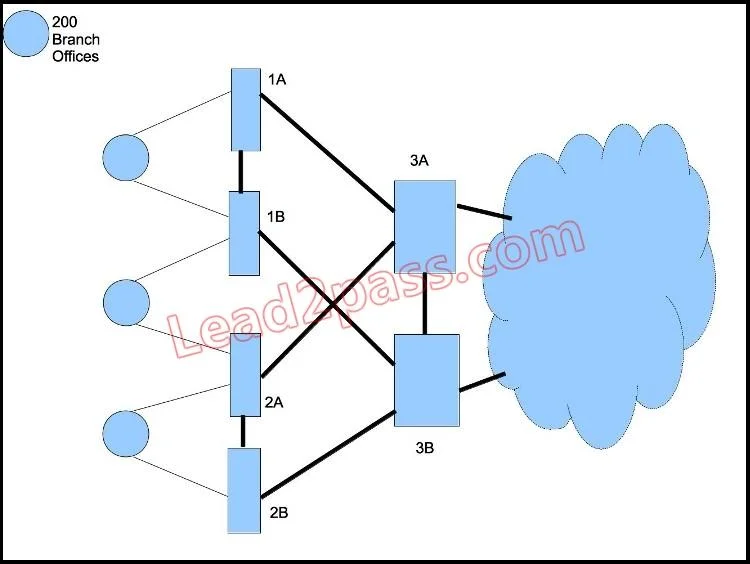
Options
- Aa single identical summary for all the branch offices placed on routers 1A, 1B, 2A, and 2B
- Btwo summaries on 1A and 1B, and two summaries on 2A and 2B
- Ca single identical summary on 3A and 3B
- Da single summary on each aggregation device for the branches connected to them
How the community answered
(22 responses)- A27% (6)
- B14% (3)
- C55% (12)
- D5% (1)
Why each option
Placing a single identical summary on 3A and 3B - the highest aggregation tier - provides the most efficient summarization while preserving optimal and stable routing during both normal operation and a single-failure event. Summarization at this tier hides all lower-layer topology changes from devices above.
Placing identical summaries on all four aggregation devices (1A, 1B, 2A, 2B) can attract traffic to a device that lacks direct connectivity to the destination branch, causing suboptimal or blackholed paths during failures.
Two separate summaries on 1A/1B and two on 2A/2B increases the prefix count advertised upward and introduces asymmetric routing risk when a link between the aggregation tier and 3A/3B fails.
A single identical summary on both 3A and 3B aggregates all branch address space into one advertisement toward the core, minimizing the routing table above that tier. During a single failure anywhere in the lower tiers, the summary remains valid and continuously advertised by both 3A and 3B, preventing route flaps from propagating upward while detailed routes within the lower tier handle the actual path adjustment.
A per-device summary covering only directly connected branches does not produce a single unified summary for the entire branch address space, resulting in more specific prefixes propagating to higher tiers and unnecessary churn during failures.
Concept tested: Optimal route summarization placement in hierarchical design
Source: https://www.cisco.com/c/en/us/td/docs/solutions/Enterprise/WAN_and_MAN/WAN_Design_Guide/WANDesign.html
Topics
Community Discussion
No community discussion yet for this question.