
300-515 · Question #150
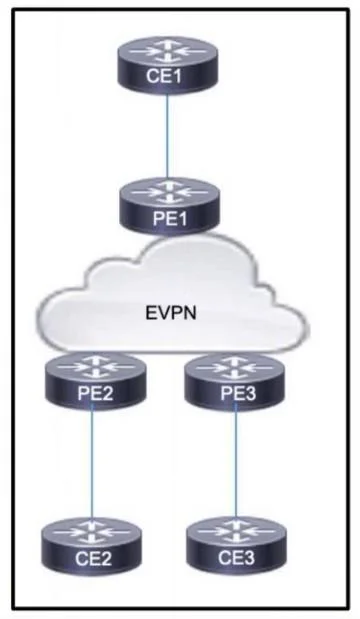
Refer to the exhibit. A service provider implemented E-Tree for a customer, with PE1 serving as the root and PE2 and PE3 as leaf nodes in the topology. Each PE router is deployed in a different…
The correct answer is C. Configure either PE2 or PE3 to be a root node. In an EVPN E-Tree service, only traffic from root nodes can be forwarded to both roots and leaves, while leaf nodes can only communicate with roots, not directly with each other. Since PE2 and PE3 are configured as leaves, they cannot exchange traffic. To allow communication…
Question
Refer to the exhibit. A service provider implemented E-Tree for a customer, with PE1 serving as the root and PE2 and PE3 as leaf nodes in the topology. Each PE router is deployed in a different physical location. PE2 and PE3 cannot communicate with one another. Which action must the network engineer take to resolve the issue?
Exhibit
Options
- AConfigure dot1q encapsulation on the L2transport interface.
- BConfigure the ICCP group in singleton mode.
- CConfigure either PE2 or PE3 to be a root node.
- DConfigure different MAC addresses for MLACP.
How the community answered
(21 responses)- A14% (3)
- B5% (1)
- C71% (15)
- D10% (2)
Explanation
In an EVPN E-Tree service, only traffic from root nodes can be forwarded to both roots and leaves, while leaf nodes can only communicate with roots, not directly with each other. Since PE2 and PE3 are configured as leaves, they cannot exchange traffic. To allow communication, one of them must be configured as a root node.
Topics
Community Discussion
No community discussion yet for this question.