
300-515 · Question #167
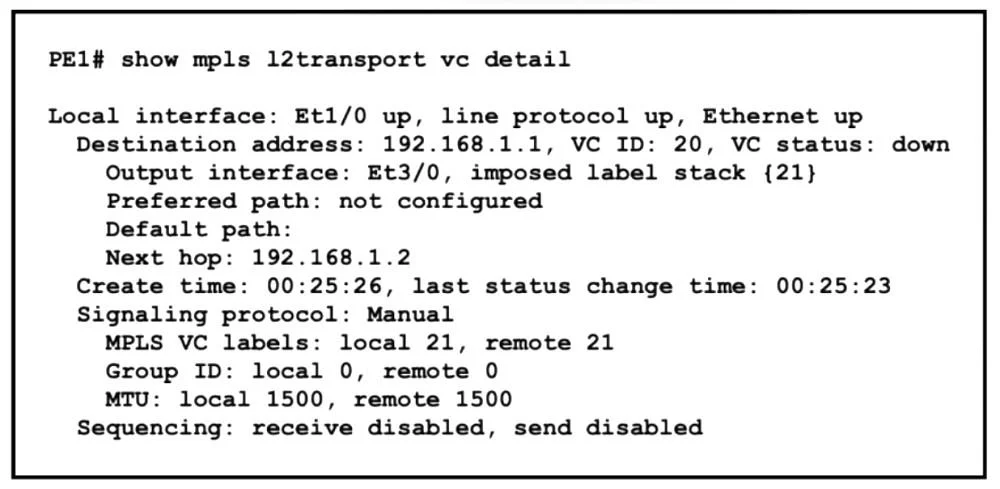
Refer to the exhibit. Routers PE1 and PE2 are in two major cities providing connectivity for a customer with offices in both locations. The customer installed a server at the main office to provide…
The correct answer is A. Change the VC IDs on the two PEs to match. For an E-Line pseudowire to come up when using manual signaling, both PEs must configure the same VC ID. The exhibit shows VC ID 20 on PE1, but the peer is using a different value, causing the pseudowire to remain down. Matching the VC IDs on both ends brings the circuit up.
Question
Refer to the exhibit. Routers PE1 and PE2 are in two major cities providing connectivity for a customer with offices in both locations. The customer installed a server at the main office to provide services to hosts at the other location over Layer 2. The networking team implemented an E-Line circuit to support the installation, but the connection failed to come up. Which action must the team take to resolve the issue and bring up the E-Line connection?
Exhibit
Options
- AChange the VC IDs on the two PEs to match.
- BConfigure the encapsulation protocol as MPLS and IP.
- CIncrease the MTUs on both PEs to support pseudowires.
- DConfigure unique MPLS labels for local and remote values.
How the community answered
(53 responses)- A77% (41)
- B4% (2)
- C11% (6)
- D8% (4)
Explanation
For an E-Line pseudowire to come up when using manual signaling, both PEs must configure the same VC ID. The exhibit shows VC ID 20 on PE1, but the peer is using a different value, causing the pseudowire to remain down. Matching the VC IDs on both ends brings the circuit up.
Topics
Community Discussion
No community discussion yet for this question.