
300-515 · Question #163
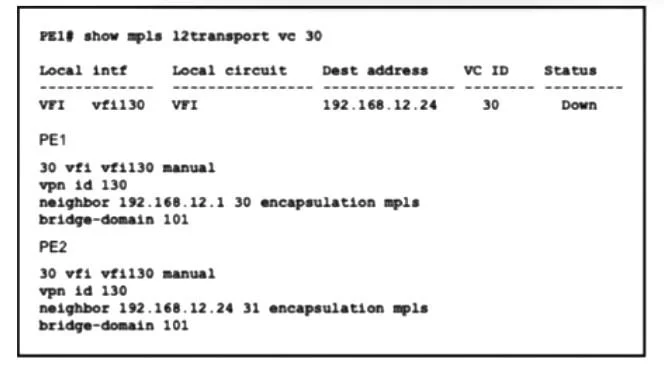
Refer to the exhibit. A customer connected to a service provider is running VPLS to extend its Layer 2 domain across hosts in two geographic regions. Servers at each site support local and remote…
The correct answer is D. Change the VC ID on PE1 to match the value on PE2. A manual VFI requires both PEs to use the same VC ID for the pseudowire to come up. In the exhibit, PE1 uses VC ID 30 while PE2 uses VC ID 31, so the pseudowire cannot establish. Matching the VC ID values on both PEs brings the VPLS circuit up.
Question
Refer to the exhibit. A customer connected to a service provider is running VPLS to extend its Layer 2 domain across hosts in two geographic regions. Servers at each site support local and remote hosts. An engineer configured PE1 and PE2 to facilitate the customer’s traffic requirements, but the circuit is down. Which action must the engineer take to resolve the issue?
Exhibit
Options
- AChange the subnet mask of the network for the connection to /30.
- BChange the VC ID on PE1 and PE2 to match the VPN ID.
- CChange the I2transport protocol on the network to IP.
- DChange the VC ID on PE1 to match the value on PE2.
How the community answered
(25 responses)- A8% (2)
- B4% (1)
- C4% (1)
- D84% (21)
Explanation
A manual VFI requires both PEs to use the same VC ID for the pseudowire to come up. In the exhibit, PE1 uses VC ID 30 while PE2 uses VC ID 31, so the pseudowire cannot establish. Matching the VC ID values on both PEs brings the VPLS circuit up.
Topics
Community Discussion
No community discussion yet for this question.