
300-515 · Question #162
SIMULATION 4 Guidelines This is a lab item in which tasks will be performed on virtual devices. Refer to the Tasks tab to view the tasks for this lab item Refer to the Topology tab to access the…
The correct answer is A. Layer 2 VPNs encapsulate Ethernet frames in MPLS packets, and Layer 3 VPNs use labeled BGP routes to distribute IP prefixes across the MPLS cloud. Note: This question has an apparent mismatch - the simulation describes Ethernet OAM configuration, but the answer choices cover MPLS VPN concepts. The choices belong to a separate question. Here's the explanation for the MPLS VPN choices as presented: Option A is correct…
Question
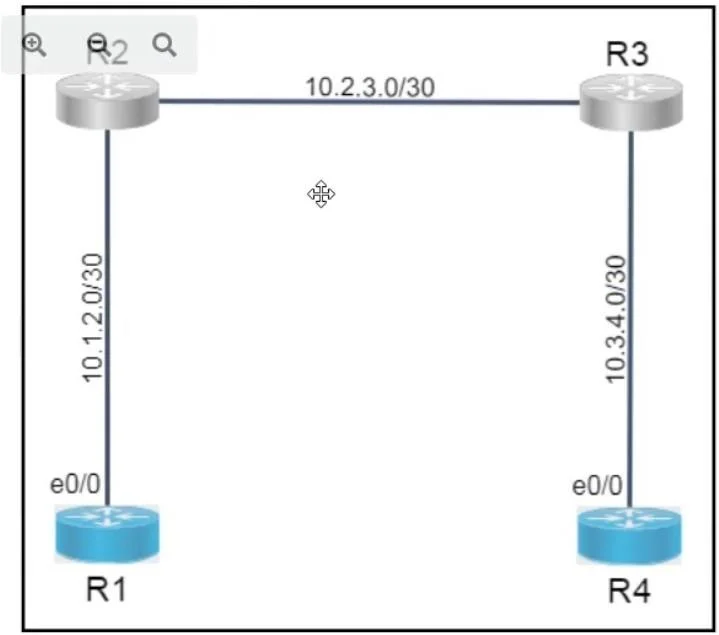
SIMULATION 4 Guidelines This is a lab item in which tasks will be performed on virtual devices. Refer to the Tasks tab to view the tasks for this lab item Refer to the Topology tab to access the device console(s) and perform the tasks. Console access is available for all required devices by clicking the device icon or using the tab(s) above the console window. All necessary pre-configurations have been applied. Do not remove any existing configurations from the devices, only those necessary to make the appropriate changes required to fulfill the listed tasks. Do not change the enable password or hostname for any device. Save your configurations to NVRAM before moving to the next item. Click Next at the bottom of the screen to submit this lab and move to the next question. When Next is clicked, the lab closes and cannot be reopened. Topology Tasks Routers R1 through R4 implement Ethernet Operations, Administration, and Maintenance operations. Perform the below configuration on R1 and R4. Configure E-OAM on interface E0/0. Configure link monitoring:
- Monitor error frames
- Set a high threshold equal to 400
- Set threshold action equal to error-disable
The initial configuration with IP addressing has been completed. Do not change the configurations except to fulfill the abovementioned tasks. Answer:
The commands enable Ethernet OAM on interface e0/0, start link-monitoring for errored frames, set the high-error threshold to 400 frames, and specify that the interface is put into err-disable state if that threshold is exceeded, exactly matching the requested behavior.
Exhibits
Options
- ALayer 2 VPNs encapsulate Ethernet frames in MPLS packets, and Layer 3 VPNs use labeled BGP routes to distribute IP prefixes across the MPLS cloud.
- BLayer 2 VPNs require the use of a Layer 2 forwarding plane with per-site MAC learning, and Layer 3 VPNs integrate Layer 2 and Layer 3 forwarding with Cisco MPLS TE for traffic differentiation.
- CLayer 2 VPNs can propagate VLAN tags across the MPLS network, and Layer 3 VPNs use BGP communities to extend MPLS labels across different VRFs.
- DLayer 2 VPNs provide Layer 2 transport using pseudowires, and Layer 3 VPNs abstract Layer 2 information using VPLS instances.
How the community answered
(46 responses)- A85% (39)
- B9% (4)
- C4% (2)
- D2% (1)
Explanation
Note: This question has an apparent mismatch - the simulation describes Ethernet OAM configuration, but the answer choices cover MPLS VPN concepts. The choices belong to a separate question. Here's the explanation for the MPLS VPN choices as presented:
Option A is correct because it accurately captures the core distinction: L2 VPNs (e.g., VPWS, VPLS) transport Ethernet frames natively across an MPLS backbone using encapsulation, while L3 VPNs (RFC 4364 / MPLS L3VPN) rely on MP-BGP to exchange VPN IPv4/IPv6 prefixes with associated MPLS labels between PE routers.
B is wrong because per-site MAC learning describes VPLS specifically (one L2VPN type), not all L2VPNs, and L3VPNs do not require MPLS TE for basic operation - TE is optional traffic engineering, not a defining L3VPN characteristic.
C is wrong because BGP communities are policy-signaling attributes, not the mechanism for distributing MPLS labels between VRFs - that role belongs to VPN labels carried in MP-BGP UPDATE messages.
D is wrong because it inverts the relationship: VPLS is itself an L2VPN technology (not an abstraction used by L3VPNs), and L3VPNs use VRFs and MP-BGP, not VPLS instances.
Memory tip: Think "L2VPN = same Ethernet, different location" (frame transport via pseudowires/MPLS encap) vs. "L3VPN = shared routing, isolated tables" (MP-BGP + VRFs + MPLS labels).
Topics
Community Discussion
No community discussion yet for this question.