
300-515 · Question #44
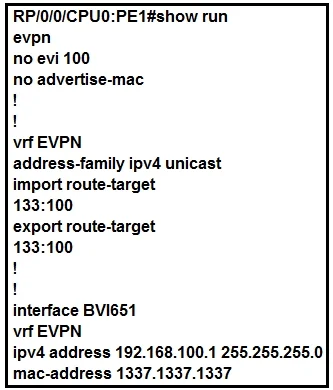
Refer to the exhibit. A network operator is implementing EVPN IRB on PE1. Which two command placements enable the advertisement of Type 2 routes and what information do Type 2 routes contain?…
The correct answer is B. Type 2 routes contain MAC/IP information. D. The operator adds in "host-routing" under the BVI651 interface. B and D are correct because in EVPN IRB, Type 2 routes are MAC/IP Advertisement routes - they carry both the MAC address and optionally the IP address of a host learned in the bridging domain, enabling remote PEs to perform both L2 and L3 forwarding. The host-routing command…
Question
Refer to the exhibit. A network operator is implementing EVPN IRB on PE1. Which two command placements enable the advertisement of Type 2 routes and what information do Type 2 routes contain? (Choose two.)
Exhibit
Options
- AThe operator adds in "host-routing" under the VRF EVPN.
- BType 2 routes contain MAC/IP information.
- CType 2 routes contain Ethernet Auto-Discovery information.
- DThe operator adds in "host-routing" under the BVI651 interface.
- EType 2 routes contain inclusive source-specific multicast route information.
How the community answered
(16 responses)- A13% (2)
- B81% (13)
- E6% (1)
Explanation
B and D are correct because in EVPN IRB, Type 2 routes are MAC/IP Advertisement routes - they carry both the MAC address and optionally the IP address of a host learned in the bridging domain, enabling remote PEs to perform both L2 and L3 forwarding. The host-routing command must be placed under the BVI (Bridge Virtual Interface) - the IRB interface itself - because that is where the bridging and routing convergence occurs, making it the logical point to trigger host route advertisement.
A is wrong because host-routing belongs on the BVI interface, not under the VRF EVPN configuration block - placing it there has no effect on Type 2 route generation. C is wrong because Ethernet Auto-Discovery information is carried in Type 1 routes, which handle redundancy and mass withdrawal for multi-homed segments. E is wrong because inclusive/source-specific multicast tree information belongs to Type 3 routes (Inclusive Multicast Ethernet Tag).
Memory tip: Use the number sequence - "1=Auto, 2=MAC/IP, 3=Multicast, 4=Segment, 5=Prefix." For configuration placement, remember that BVI is the IRB interface (Bridge + Routing = BVI), so anything affecting host advertisement in IRB lives on the BVI, not the VRF.
Topics
Community Discussion
No community discussion yet for this question.