
300-515 · Question #64
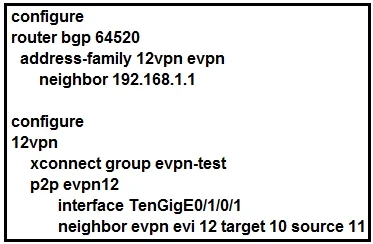
Refer to the exhibit. Which effect of this configuration is true?
The correct answer is B. It configures VPWS single homed. VPWS Single-Homed Configuration Option B is correct because the configuration shown establishes a basic point-to-point pseudowire (VPWS) with a single attachment circuit connecting to one PE router - the hallmark of single-homed operation. A single-homed VPWS lacks the…
Question
Refer to the exhibit. Which effect of this configuration is true?
Exhibit
Options
- AIt configures VPWS multihomed.
- BIt configures VPWS single homed.
- CIt configures an IPv4 peering with 192.168.1.1
- DIt configures MPLS traffic engineering.
How the community answered
(34 responses)- A6% (2)
- B88% (30)
- C3% (1)
- D3% (1)
Explanation
VPWS Single-Homed Configuration
Option B is correct because the configuration shown establishes a basic point-to-point pseudowire (VPWS) with a single attachment circuit connecting to one PE router - the hallmark of single-homed operation. A single-homed VPWS lacks the redundancy mechanisms (such as an Ethernet Segment Identifier or ESI, and EVPN multi-homing route types) that would indicate multihomed operation, ruling out A. Option C is incorrect because while BGP peering may be present, VPWS configurations use BGP for pseudowire signaling/label exchange - not to establish a simple IPv4 routing peer relationship. Option D is wrong because MPLS-TE requires explicit tunnel configuration with RSVP-TE or similar, which is a separate feature from VPWS L2VPN services.
Memory tip: Think "single-homed = single path, no ESI." If you see an ESI value or redundancy group in the config, it's multihomed. No ESI = single-homed VPWS.
Topics
Community Discussion
No community discussion yet for this question.