
300-515 · Question #141
Refer to the exhibit. A customer connected to a service provider is running VPLS. Client applications require the extension of Layer 2 between sites. However, the customer's security team wants to…
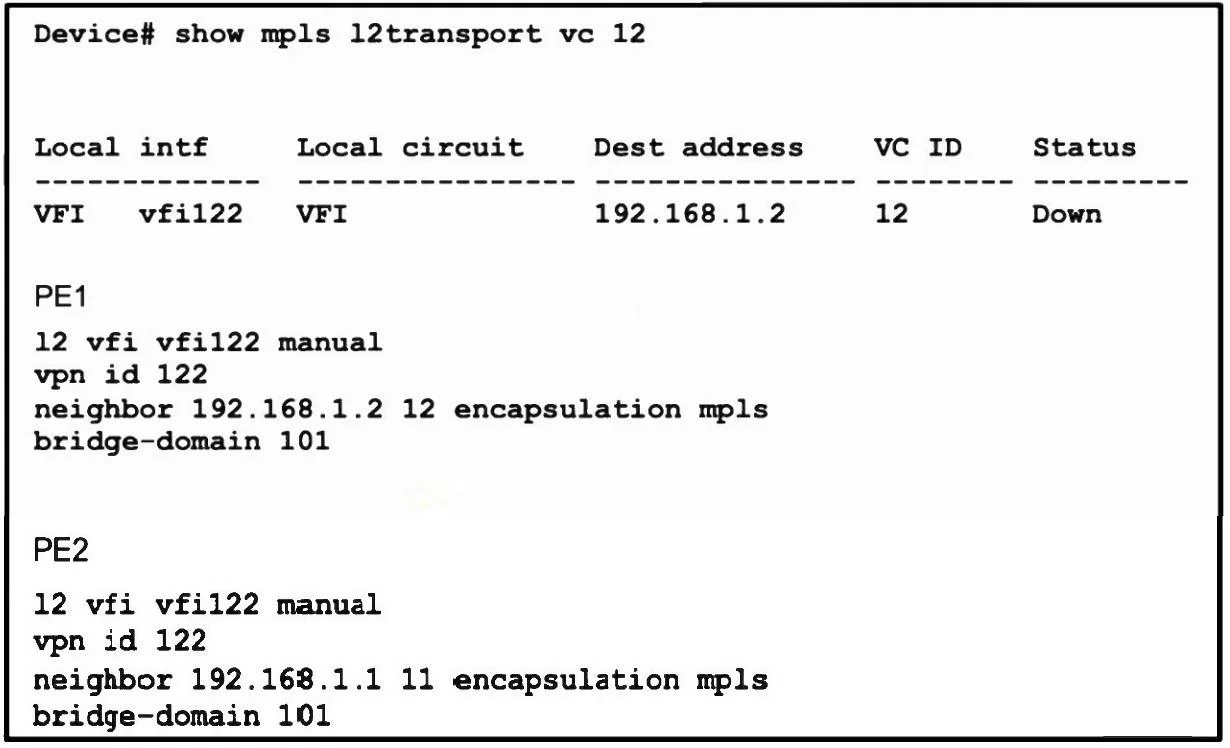
The correct answer is A. Change the VC ID on PE2 to match the value on R1. In a VPLS configuration, both PEs must use the same VC ID for the pseudowire to come up. In the provided config, PE1 uses neighbor 192.168.1.2 12 (VC ID 12), while PE2 uses neighbor 192.168.1.1 11 (VC ID 11). Because these IDs don’t match, the VC remains down. Correcting PE2 to…
Question
Refer to the exhibit. A customer connected to a service provider is running VPLS. Client applications require the extension of Layer 2 between sites. However, the customer’s security team wants to prevent Layer 3 routing from being shared with its service provider. An engineer at the service provider configured PE1 and PE2 as shown to facilitate the customer’s traffic requirements, but the circuit is down. Which action must the engineer take to resolve the issue?
Exhibit
Options
- AChange the VC ID on PE2 to match the value on R1.
- BChange the VC ID on PE1 and PE2 to match the VPN ID.
- CChange the bridge ID on PE1 and PE2 to match the VC ID.
- DChange the VPN ID on either router so that the two values are unique.
How the community answered
(46 responses)- A61% (28)
- B7% (3)
- C22% (10)
- D11% (5)
Explanation
In a VPLS configuration, both PEs must use the same VC ID for the pseudowire to come up. In the provided config, PE1 uses neighbor 192.168.1.2 12 (VC ID 12), while PE2 uses neighbor 192.168.1.1 11 (VC ID 11). Because these IDs don’t match, the VC remains down. Correcting PE2 to use VC ID 12 ensures that both sides are consistent, bringing the pseudowire up.
Topics
Community Discussion
No community discussion yet for this question.