
300-515 · Question #142
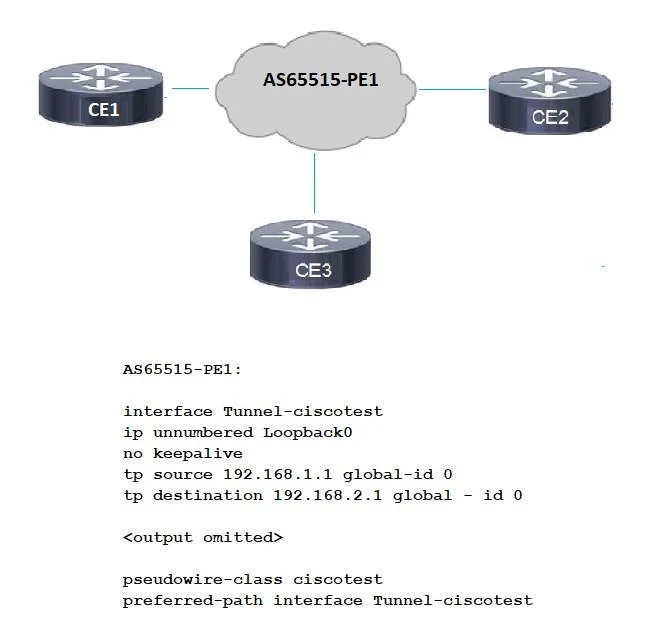
Refer to the exhibit. A customer has multiple physical locations connected by an ISP in AS 65516 that runs MPLS in the core. Customer traffic passes through the ISP core using Layer 2. A network…
The correct answer is D. Configure the pseudowire encapsulation to be MPLS. The ISP core is MPLS-enabled, so the AToM pseudowire between PEs must use encapsulation mpls. Without MPLS encapsulation on the xconnect/pseudowire, the VC will not come up and traffic (the ping) fails. Configuring the pseudowire to use MPLS encapsulation resolves the issue.
Question
Refer to the exhibit. A customer has multiple physical locations connected by an ISP in AS 65516 that runs MPLS in the core. Customer traffic passes through the ISP core using Layer 2. A network engineer just configured a pseudowire to provide better service. However, when the engineer verified connectivity using a continuous ping between sites, the ping failed. Which action resolves the issue?
Exhibit
Options
- AConfigure a static route for the pseudowire to identify which path to use to reach the tunnel
- BConfigure MPLS Traffic Engineering tunnels in the global configuration for all devices in AS
- CConfigure the tunnel source and destination to be in the same subnet.
- DConfigure the pseudowire encapsulation to be MPLS.
How the community answered
(37 responses)- A5% (2)
- B11% (4)
- C27% (10)
- D57% (21)
Explanation
The ISP core is MPLS-enabled, so the AToM pseudowire between PEs must use encapsulation mpls. Without MPLS encapsulation on the xconnect/pseudowire, the VC will not come up and traffic (the ping) fails. Configuring the pseudowire to use MPLS encapsulation resolves the issue.
Topics
Community Discussion
No community discussion yet for this question.