
300-515 · Question #149
Refer to the exhibit. A service provider network uses BGP as its PE-to-CE routing protocol. Customer A is dual-homed to the service provider via CE1. A network engineer is implementing EVPN native…
The correct answer is D. Configure PE1 and PE2 with the same ESI. EVPN all-active multihoming requires both PEs that connect to the same CE to share the identical Ethernet Segment Identifier (ESI). Using the same ESI signals a single multihomed Ethernet segment, enabling DF election and active/active load balancing for the CE’s traffic.
Question
Refer to the exhibit. A service provider network uses BGP as its PE-to-CE routing protocol. Customer A is dual-homed to the service provider via CE1. A network engineer is implementing EVPN native with active load balancing so that customer A’s traffic can more efficiently use both links. Which action must the engineer take?
Exhibit
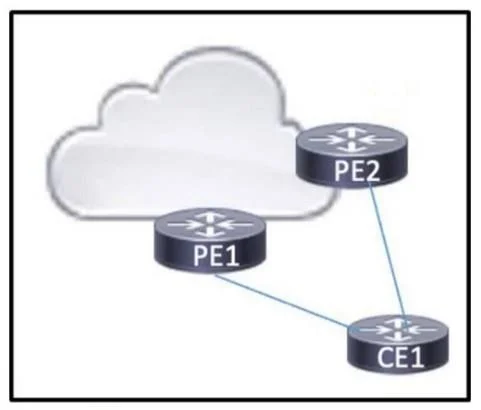
Options
- AConfigure CE1 to send labels through BGP.
- BConfigure PE1 and PE2 for ARP suppression.
- CConfigure separate physical interfaces on CE1 for the two PE connections.
- DConfigure PE1 and PE2 with the same ESI.
How the community answered
(34 responses)- A6% (2)
- B12% (4)
- C3% (1)
- D79% (27)
Explanation
EVPN all-active multihoming requires both PEs that connect to the same CE to share the identical Ethernet Segment Identifier (ESI). Using the same ESI signals a single multihomed Ethernet segment, enabling DF election and active/active load balancing for the CE’s traffic.
Topics
Community Discussion
No community discussion yet for this question.