
300-515 · Question #151
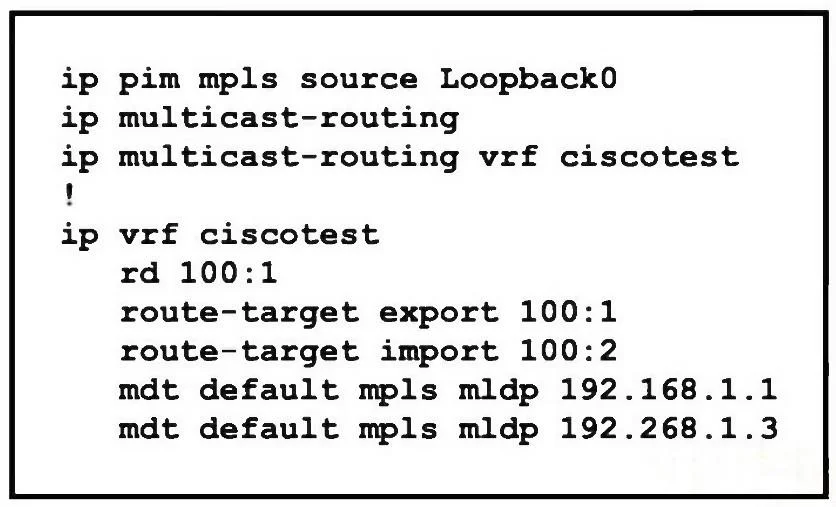
Refer to the exhibit. A network engineer applies a configuration to multiple PE routers participating in an MLDP. Each PE creates the same VRF to support a single customer, which has officers…
The correct answer is A. Set a common VPN ID on each participating PE. For multicast VPNs (mVPNs) using MLDP as the transport, each PE must share a common VPN ID across the VRFs that belong to the same customer. This VPN ID uniquely identifies the multicast domain and ensures that multicast trees are built consistently across all participating…
Question
Refer to the exhibit. A network engineer applies a configuration to multiple PE routers participating in an MLDP. Each PE creates the same VRF to support a single customer, which has officers located in several different regions. The PEs provide connectivity for hosts that use multicast services across a VPN. After the configuration is applied and the PEs are brought up, which additional action must the engineer take to enable multicast in the network?
Exhibit
Options
- ASet a common VPN ID on each participating PE.
- BEnable PE routers to send labels for multicast traffic only.
- CImplement PIM-DM on all P routers within the service provider core.
- DImplement bidirectional PIM on all PE routers within the service provider core.
How the community answered
(20 responses)- A85% (17)
- C10% (2)
- D5% (1)
Explanation
For multicast VPNs (mVPNs) using MLDP as the transport, each PE must share a common VPN ID across the VRFs that belong to the same customer. This VPN ID uniquely identifies the multicast domain and ensures that multicast trees are built consistently across all participating PEs, enabling end-to-end multicast connectivity.
Topics
Community Discussion
No community discussion yet for this question.