
300-515 · Question #8
Refer to the exhibit. What is the effect of this configuration?
The correct answer is B. Router 1 accepts multicast routes with a tag of 12:1. Option B is correct because the exhibited configuration uses a route-map with a match tag statement referencing tag 12:1, which acts as a filter controlling which multicast routes Router 1 will accept - only those carrying that specific tag value pass the permit condition and…
Question
Refer to the exhibit. What is the effect of this configuration?
Exhibit
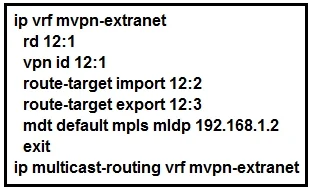
Options
- AThe mroute table is cleared.
- BRouter 1 accepts multicast routes with a tag of 12:1
- CA Cisco MPLS TE tunnel is generated with 192.168.1.2 as the source IP address of router 1.
- DAn LSP virtual interface tunnel is created.
How the community answered
(51 responses)- A8% (4)
- B75% (38)
- C4% (2)
- D14% (7)
Explanation
Option B is correct because the exhibited configuration uses a route-map with a match tag statement referencing tag 12:1, which acts as a filter controlling which multicast routes Router 1 will accept - only those carrying that specific tag value pass the permit condition and populate the multicast routing table.
Why the distractors are wrong:
- A is wrong because clearing the mroute table requires an active
clear ip mroutecommand, not a passive route-map or tag configuration. - C is wrong because generating an MPLS TE tunnel requires
tunnel mode mpls traffic-engalong with RSVP and TE-specific commands - a multicast tag match does none of that. - D is wrong because LSP virtual interfaces are MPLS constructs built through LDP/RSVP label exchange, which is entirely unrelated to multicast route filtering via tags.
Memory tip: Think of the tag as a wristband at a venue door - the route-map is the bouncer who only lets in guests (routes) wearing wristband 12:1. Tags filter; they don't build tunnels or wipe tables.
Topics
Community Discussion
No community discussion yet for this question.