
300-515 · Question #7
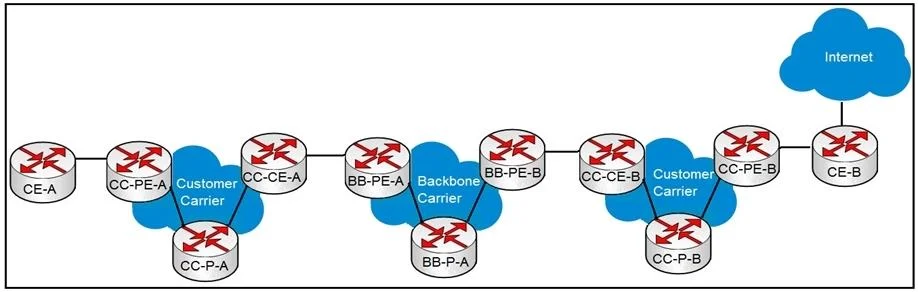
Refer to the exhibit. A customer carrier running MPLS VPN wants to utilize a backbone carrier to forward traffic and exchange VPNv4 prefixes between the two customer carrier networks depicted. Which…
The correct answer is B. CC-PE-A and CC-PE-B C. BB-PE-A and BB-PE-B. In Carrier Supporting Carrier (CSC) architecture, two separate iBGP planes must exist - one within each autonomous system. The customer carrier's PE routers (CC-PE-A and CC-PE-B) must establish MP-iBGP to exchange VPNv4 prefixes for their own VPN customers across the backbone…
Question
Refer to the exhibit. A customer carrier running MPLS VPN wants to utilize a backbone carrier to forward traffic and exchange VPNv4 prefixes between the two customer carrier networks depicted. Which two sets of routers must establish MP-iBGP sessions? (Choose two.)
Exhibit
Options
- ABB-PE-A and CC-PE-B
- BCC-PE-A and CC-PE-B
- CBB-PE-A and BB-PE-B
- DCC-PE-A and BB-PE-A
- EBB-PE-A and BB-P-A
- FCC-PE-A and CC-P-A
How the community answered
(53 responses)- A13% (7)
- B77% (41)
- D2% (1)
- E2% (1)
- F6% (3)
Explanation
In Carrier Supporting Carrier (CSC) architecture, two separate iBGP planes must exist - one within each autonomous system. The customer carrier's PE routers (CC-PE-A and CC-PE-B) must establish MP-iBGP to exchange VPNv4 prefixes for their own VPN customers across the backbone, while the backbone carrier's PE routers (BB-PE-A and BB-PE-B) must establish MP-iBGP to exchange labeled IPv4 routes used to stitch the LSP across the backbone provider network.
Why the distractors are wrong:
- A (BB-PE-A ↔ CC-PE-B): These routers are in different ASes on opposite ends of the network - no direct session is needed or practical between them.
- D (CC-PE-A ↔ BB-PE-A): This session does exist, but it is eBGP (inter-AS labeled unicast), not iBGP - the question specifically asks for MP-iBGP.
- E (BB-PE-A ↔ BB-P-A): P (core) routers in the backbone don't participate in BGP at all; they simply forward labeled packets using the existing LSP.
- F (CC-PE-A ↔ CC-P-A): Same reasoning - customer carrier P routers forward traffic via MPLS but don't need MP-BGP sessions.
Memory tip: "iBGP stays in-house" - each carrier only runs iBGP within its own AS (CC-PE↔CC-PE for VPNv4, BB-PE↔BB-PE for labeled routes). Anything crossing AS boundaries is eBGP, and P routers never touch BGP in this design.
Topics
Community Discussion
No community discussion yet for this question.