
300-515 · Question #10
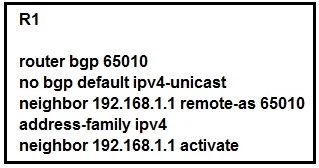
Refer to the exhibit. Which statement describes the result of this BGP configuration?
The correct answer is D. R1 establishes an iBGP relationship with peer 192.168.1.1. Option D is correct because the exhibit's BGP configuration shows neighbor 192.168.1.1 remote-as set to the same AS number as R1 itself, which by definition creates an iBGP (internal BGP) peering session - both routers share the same Autonomous System. Why the distractors are…
Question
Refer to the exhibit. Which statement describes the result of this BGP configuration?
Exhibit
Options
- AR1 operates using IPv4 and VPNv4 address families.
- BR1 operates on IPv6 only because the bgp default ipv4-unicast command is missing.
- CR1 establishes a VPNv4 eBGP relationship with neighbor 192.168.1.1.
- DR1 establishes an iBGP relationship with peer 192.168.1.1.
How the community answered
(21 responses)- A5% (1)
- B5% (1)
- D90% (19)
Explanation
Option D is correct because the exhibit's BGP configuration shows neighbor 192.168.1.1 remote-as set to the same AS number as R1 itself, which by definition creates an iBGP (internal BGP) peering session - both routers share the same Autonomous System.
Why the distractors are wrong:
- A is wrong because operating with VPNv4 requires an explicit
address-family vpnv4block; the exhibit shows no such configuration. - B is wrong because Cisco IOS enables
bgp default ipv4-unicastby default - its absence from the config doesn't disable IPv4 or force IPv6-only operation. - C is wrong on two counts: eBGP requires different AS numbers between peers, and VPNv4 requires explicit address-family activation - neither condition is met here.
Memory tip: Think of the "i" in iBGP as "internal" - if the remote-as number matches your own router's AS, you're staying internal = iBGP. Different AS = external = eBGP. On exam questions, always check whether the remote-as value matches the router bgp AS number first.
Topics
Community Discussion
No community discussion yet for this question.