
300-510 · Question #58
Refer to the exhibit. An engineer has successfully fixed BGP peering issue. R1 has an established eBGP peering with R2 and R3. Which mechanism should the engineer apply in order to steer the traffic…
The correct answer is D. The IGP metric can be manipulated on R1 to allow traffic to be load balanced between R2 and. When R1 receives the same BGP prefix from both R2 and R3 via eBGP and all other BGP decision attributes are equal (weight, local preference, AS path length, origin, MED), the tiebreaker in the BGP decision process is the IGP metric to the eBGP next hop. By manipulating IGP…
Question
Refer to the exhibit. An engineer has successfully fixed BGP peering issue. R1 has an established eBGP peering with R2 and R3. Which mechanism should the engineer apply in order to steer the traffic correctly?
Exhibit
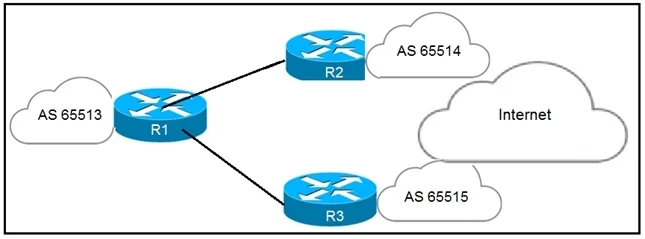
Options
- AThe MED attribute can be applied on R2 to influence R1 to use it as the primary path.
- BThe local preference attribute can be applied on R3 to influence AS 65513 to use AS 65515 as
- CThe weight attribute can be applied on R2 to influence AS 65513 to use AS 65515 as the primary
- DThe IGP metric can be manipulated on R1 to allow traffic to be load balanced between R2 and
How the community answered
(65 responses)- A5% (3)
- B9% (6)
- C3% (2)
- D83% (54)
Explanation
When R1 receives the same BGP prefix from both R2 and R3 via eBGP and all other BGP decision attributes are equal (weight, local preference, AS path length, origin, MED), the tiebreaker in the BGP decision process is the IGP metric to the eBGP next hop. By manipulating IGP metrics on R1 so that the cost to both R2 and R3 next hops is equal, R1 can load-balance traffic across both eBGP peers. Option A is wrong because MED is used to influence how external ASes send traffic INTO the local AS, not for load balancing outbound. Option B is wrong because local preference is an iBGP attribute and cannot be sent via eBGP to influence another AS. Option C is wrong because weight is a Cisco-proprietary attribute that is local to R2 and would affect R2's own routing decisions, not AS 65513's outbound path selection.
Topics
Community Discussion
No community discussion yet for this question.