
300-510 · Question #273
Refer to the exhibit. IS-IS runs in the network and all routers are in the same area R1 statically routes to distribute traffic with R6 and the networking team has redistributed the static routes on…
The correct answer is C. Configure the IS-IS routers with metric-style wide. By default IS-IS on Cisco uses the “narrow” metric style, which cannot carry the external-route TLV (and its route-tag) needed when you redistribute static routes. Enabling metric-style wide causes the IS-IS PDUs to include the extended TLV space for externals (and tags), so…
Question
Refer to the exhibit. IS-IS runs in the network and all routers are in the same area R1 statically routes to distribute traffic with R6 and the networking team has redistributed the static routes on R1 into IS-IS. Hosts on R3 need access to servers connected to R6. A tag has been applied to the routes to manipulate routes along the path but routers running IS-IS are still unable to reach the redistributed routes. Which action must the team take to resolve the issue?
Exhibit
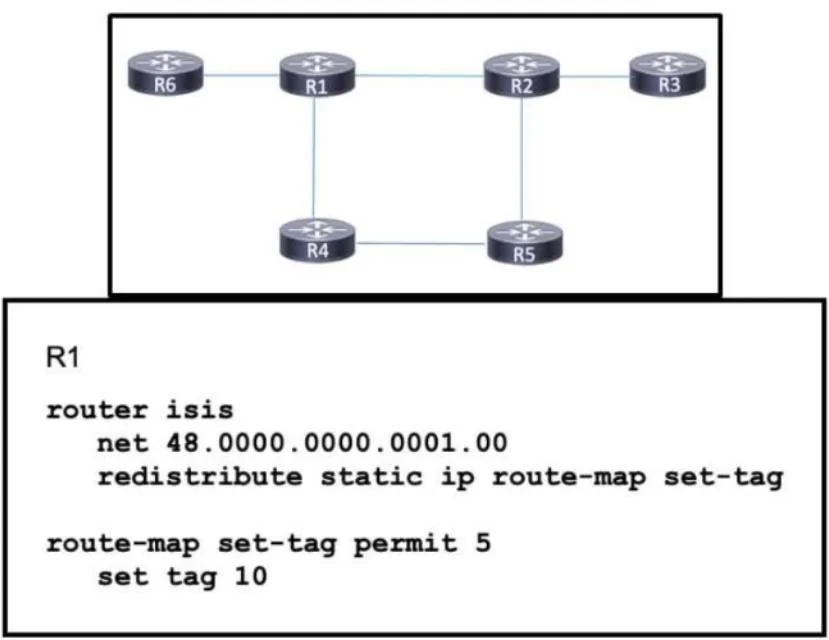
Options
- AConfigure the routers as Level 1/Level 2 routers
- BConfigure R3 with a default route that uses R2 as the next hop
- CConfigure the IS-IS routers with metric-style wide
- DConfigure the route map with an additional route-map set-tag permit 10 sequence
How the community answered
(41 responses)- A5% (2)
- B7% (3)
- C73% (30)
- D15% (6)
Explanation
By default IS-IS on Cisco uses the “narrow” metric style, which cannot carry the external-route TLV (and its route-tag) needed when you redistribute static routes. Enabling metric-style wide causes the IS-IS PDUs to include the extended TLV space for externals (and tags), so that the redistributed prefixes actually propagate throughout the IS-IS domain.
Topics
Community Discussion
No community discussion yet for this question.