
300-510 · Question #272
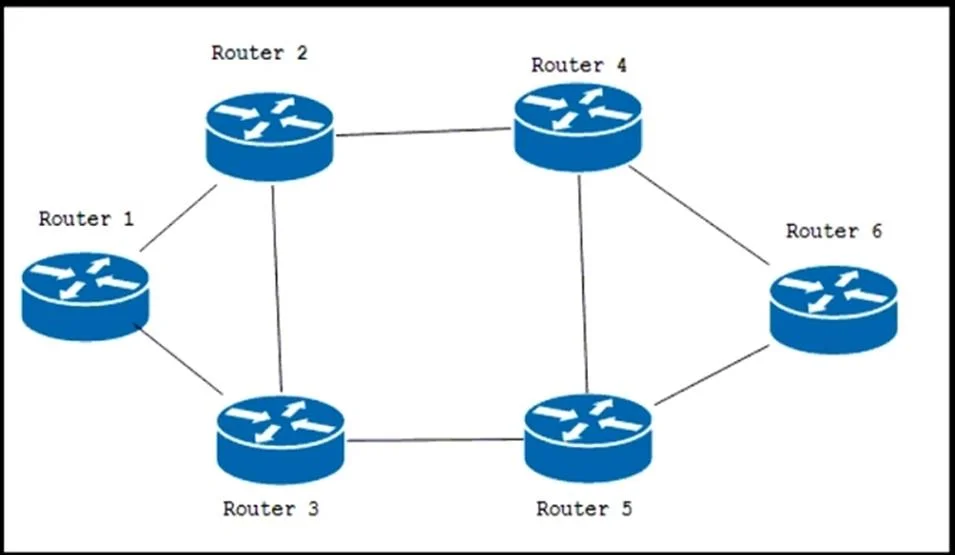
Refer to the exhibit. Router 1, Router 2, and Router 3 are co-located in an onsite data center of an office, but Router 4, Router 5, and Router 6 are installed in another data center several miles…
The correct answer is C. FRR. RSVP-TE (Resource Reservation Protocol - Traffic Engineering) is used to establish MPLS Traffic Engineering tunnels. When an interface on Router 3 is taken down, there is traffic disruption because no backup path is immediately available. Other routers are able to redirect…
Question
Refer to the exhibit. Router 1, Router 2, and Router 3 are co-located in an onsite data center of an office, but Router 4, Router 5, and Router 6 are installed in another data center several miles away. A network engineer is troubleshooting an RSVP- issue on the network. On most of the devices, the engineer can move all LSPs away from a selected interface and take it down for maintenance without interrupting traffic. However, when an interface on Router 3 is taken down, traffic on the network is disrupted. What must the engineer enable to resolve the issue on Router 3?
Exhibit
Options
- Asoft-disperse feature
- Bsoft-preemption feature
- CFRR
- DNSR
How the community answered
(33 responses)- A6% (2)
- B3% (1)
- C76% (25)
- D15% (5)
Explanation
RSVP-TE (Resource Reservation Protocol - Traffic Engineering) is used to establish MPLS Traffic Engineering tunnels. When an interface on Router 3 is taken down, there is traffic disruption because no backup path is immediately available. Other routers are able to redirect traffic without issues, which indicates that Fast Reroute (FRR) is missing on Router 3. FRR provides a local repair mechanism for MPLS TE tunnels. It allows a router to pre-calculate and pre-establish backup paths (also called detour paths) for primary LSPs. When the primary link or interface fails, traffic is rerouted immediately onto the backup path without significant delay. By enabling FRR on Router 3, the LSPs will have pre-established backup paths, ensuring that traffic is redirected without disruption during interface maintenance or failure.
Topics
Community Discussion
No community discussion yet for this question.