
300-510 · Question #256
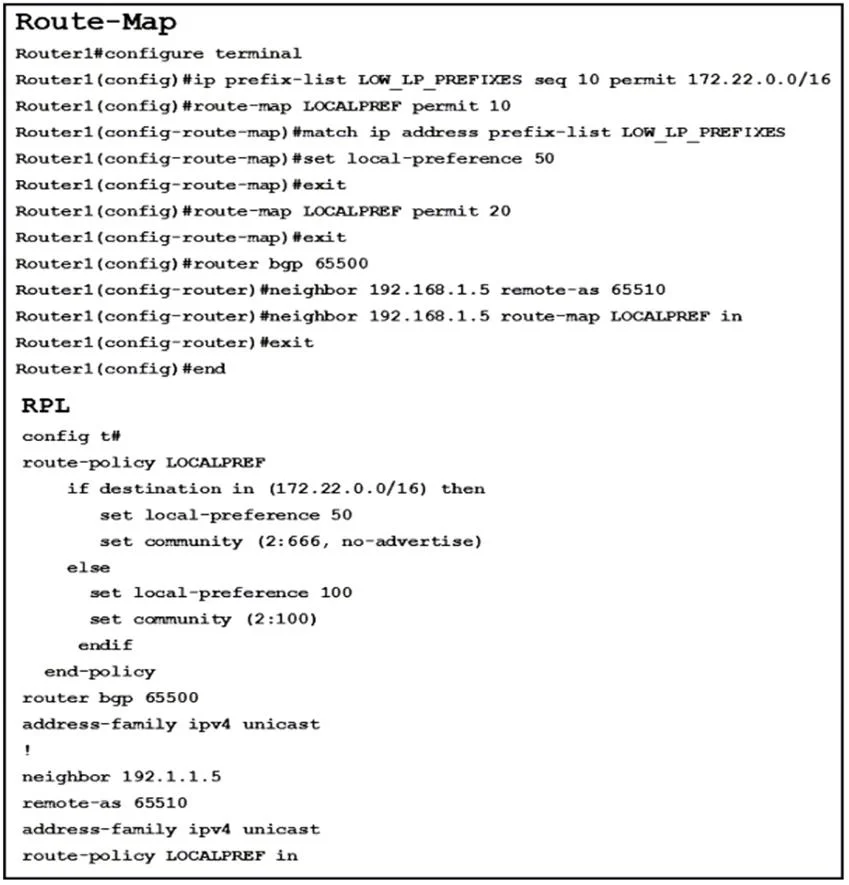
Refer to the exhibit. An engineer is comparing these RPL and route map configurations. Which two conclusions will the engineer reach? (Choose two.)
The correct answer is C. RPL is applying local preference 50 and community (2:666) for prefix 172.22.0.0/16, but the route D. RPL is applying local preference 100 and community (2:100) for multiple prefixes, but the route. RPL is applying local preference 50 and community (2:666) for prefix 172.22.0.0/16, but the route map is applying only local preference 50 for the same prefix. The RPL configuration applies both local preference 50 and community (2:666, no-advertise) for the prefix…
Question
Refer to the exhibit. An engineer is comparing these RPL and route map configurations. Which two conclusions will the engineer reach? (Choose two.)
Exhibit
Options
- ARPL is applying local preference 50 and community (2:666) for all prefixes, but the route map is
- BRPL and the route map are applying only local preference 50 for prefix 172.22.0.0/16.
- CRPL is applying local preference 50 and community (2:666) for prefix 172.22.0.0/16, but the route
- DRPL is applying local preference 100 and community (2:100) for multiple prefixes, but the route
- ERPL is applying policy only on BGP IPv6 address families, but the route map is applying policy on
How the community answered
(31 responses)- A32% (10)
- B10% (3)
- C42% (13)
- E16% (5)
Explanation
RPL is applying local preference 50 and community (2:666) for prefix 172.22.0.0/16, but the route map is applying only local preference 50 for the same prefix. The RPL configuration applies both local preference 50 and community (2:666, no-advertise) for the prefix 172.22.0.0/16. The route map, however, matches the same prefix using the prefix list LOW_LP_PREFIXES but only applies local preference 50. There is no community set in the route RPL is applying local preference 100 and community (2:100) for multiple prefixes, but the route map is applying default local preference for multiple prefixes. In the RPL configuration, prefixes other than 172.22.0.0/16 (i.e., in the else block) are assigned local preference 100 and community (2:100). The route map does not explicitly configure a local preference for unmatched prefixes, so the default BGP local preference (100) is applied. The key difference is that the RPL also sets a community (2:100) for the other prefixes, which is not applied by the route map.
Topics
Community Discussion
No community discussion yet for this question.