
300-510 · Question #231
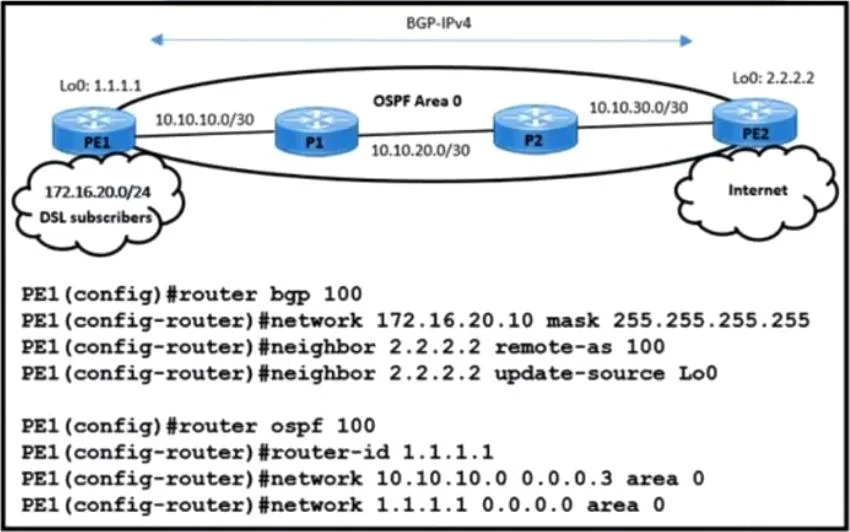
Refer to the exhibit. The engineering team noticed route disruptions when DSL subscriber 172.16.20.10 goes offline. In this service provider environment: - The OSPF backbone area is configured to…
The correct answer is B. R2#router bgp 200 neighbor 12.12.12.2 remote-as 100 neighbor 23.23.23.2 remote-as 300 neighbor 12.12.12.2 filter-list 1 out ip as-path access-list 1 deny ^400$ ip as-path access-list 1 permit .*. Option B is correct because it applies an outbound AS-path filter on R2 that blocks routes originated solely in AS 400 (deny ^400$) from being advertised to the neighboring AS, while permitting all other routes. This stops the route flap caused by the DSL subscriber's…
Question
Refer to the exhibit. The engineering team noticed route disruptions when DSL subscriber 172.16.20.10 goes offline. In this service provider environment:
- The OSPF backbone area is configured to advertise loopback prefixes.
- The PE routers are running BGP-IPv4 address family in a BGP-free core
topology.
- The DSL subscriber IP subnet 172.16.20.10/32 is redistributed in BGP
on PE1. Which configuration on PE1 resolves the issue? A. B. C. D.
Exhibits



Options
- AR2#router bgp 200 address-family ipv4 unicast neighbor 12.12.12.2 remote-as 100 neighbor 12.12.12.2 activate neighbor 12.12.12.2 route-map PREPEND out exit-address-family ! route-map PREPEND permit 10 set as-path prepend 100 100
- BR2#router bgp 200 neighbor 12.12.12.2 remote-as 100 neighbor 23.23.23.2 remote-as 300 neighbor 12.12.12.2 filter-list 1 out ip as-path access-list 1 deny ^400$ ip as-path access-list 1 permit .*
- CR1#router bgp 100 neighbor 12.12.12.1 remote-as 200 neighbor 12.12.12.1 route-map SET-LOCAL-PREF in route-map SET-LOCAL-PREF permit 10 match ip address 2 set local-preference 700 route-map SET-LOCAL-PREF permit 20 access-list 2 permit 150.0.0.0 0.255.255.255 access-list 2 deny any
- DR2#router bgp 200 neighbor 12.12.12.2 route-map FLOODING out ip as-path access-list 1 permit ^400_ route-map FLOODING permit 10 match as-path 1 set metric 50000
How the community answered
(26 responses)- A23% (6)
- B62% (16)
- C4% (1)
- D12% (3)
Explanation
Option B is correct because it applies an outbound AS-path filter on R2 that blocks routes originated solely in AS 400 (deny ^400$) from being advertised to the neighboring AS, while permitting all other routes. This stops the route flap caused by the DSL subscriber's 172.16.20.10/32 being repeatedly advertised and withdrawn as the subscriber cycles online/offline, preventing that instability from propagating to BGP peers.
Option A is wrong because AS-path prepending only influences route preference by lengthening the AS path - it doesn't suppress or filter the unstable route, so disruptions still propagate. Option C is wrong because setting local preference controls traffic engineering within an AS (preferring one exit path over another), and has no effect on whether the flapping route is advertised externally. Option D is wrong because setting a high MED (metric) merely makes the route less preferred when multiple paths exist - it does not prevent the advertisement or withdrawal of the unstable subscriber route.
Memory tip: Master AS-path regex anchors for the exam - ^ means "starts with," $ means "ends with," and _ is a wildcard delimiter. So ^400$ matches routes originating exclusively from AS 400 (nothing before or after), making it the precise tool to filter a specific subscriber AS without affecting transit routes.
Topics
Community Discussion
No community discussion yet for this question.