
300-510 · Question #232
Refer to the exhibit. An engineer at a large ISP is troubleshooting suboptimal routing on a customer's IS-IS network with multiple Level 1-2 routers. The network consists of numerous routers that…
The correct answer is A. Redistribute Level 2 prefixes into Level 1 on router 2. In IS-IS, Level 1 routers only maintain intra-area routing information. When they need to reach destinations outside their area, they rely on the closest Level 1-2 (L1/L2) router, which sets the 'attached bit' in its LSP to signal reachability to the Level 2 backbone. The…
Question
Refer to the exhibit. An engineer at a large ISP is troubleshooting suboptimal routing on a customer's IS-IS network with multiple Level 1-2 routers. The network consists of numerous routers that are configured for MPLS. When IS-IS picks the closest Level 1-2 router to exit the area, suboptimal routing occurs in Area 8 and Area 10. The other IGP protocols are running correctly, and the IS-IS adjacency between routers is established. Which action resolves the issue?
Exhibit
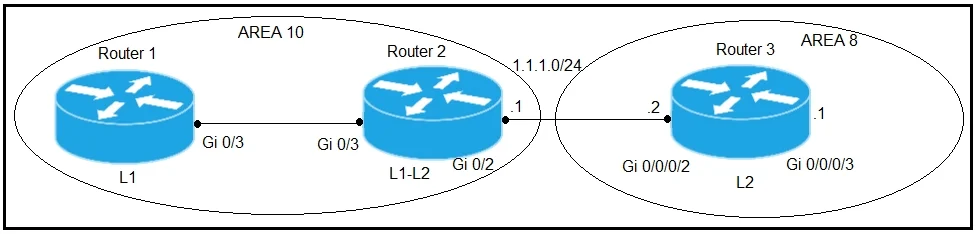
Options
- ARedistribute Level 2 prefixes into Level 1 on router 2.
- BDisable advertisement of the default route on router 2.
- CConfigure each interface as either Level 1 or Level 2 circuit type on router 1.
- DConfigure the router as DIS for each of the interfaces on router 1.
How the community answered
(37 responses)- A73% (27)
- B16% (6)
- C3% (1)
- D8% (3)
Explanation
In IS-IS, Level 1 routers only maintain intra-area routing information. When they need to reach destinations outside their area, they rely on the closest Level 1-2 (L1/L2) router, which sets the 'attached bit' in its LSP to signal reachability to the Level 2 backbone. The problem is that Level 1 routers blindly route to the nearest L1/L2 router regardless of whether it leads to the optimal exit point - this is the root cause of suboptimal routing in Area 8 and Area 10. The fix is to redistribute Level 2 prefixes (inter-area and external routes) into the Level 1 domain on Router 2. This gives Level 1 routers full routing information about external destinations, allowing them to make topology-aware decisions rather than simply defaulting to the closest L1/L2 router. Option B is wrong (disabling the default route would break connectivity). Option C applies to interface circuit types, not the routing decision itself. Option D (DIS election) controls the designated IS on broadcast networks and is unrelated to suboptimal path selection.
Topics
Community Discussion
No community discussion yet for this question.