
300-510 · Question #233
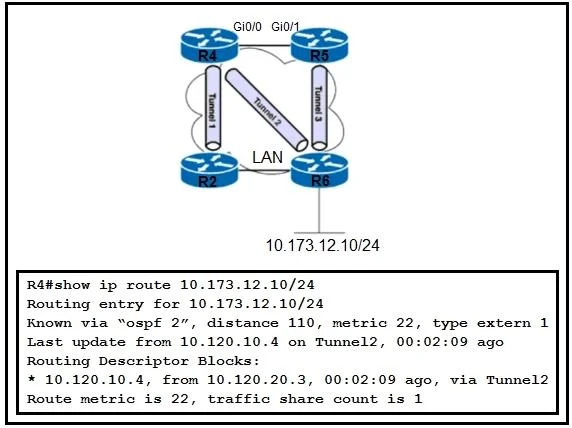
Refer to the exhibit. OSPF is an interior routing protocol on the network. Routers R4 and R6 are in area 0, and all tunnels are in area 2. R4 is connected to R6 with a 1 Gbps link and with 100 Mbps…
The correct answer is A. Configure auto-cost reference-bandwidth 1000 under the global OSPF configuration on R4. OSPF calculates interface cost using the formula: Cost = Reference-Bandwidth / Interface-Bandwidth. The default reference-bandwidth is 100 Mbps. With this default, any interface at 100 Mbps or faster receives a minimum cost of 1 (OSPF does not use fractional costs). This means…
Question
Refer to the exhibit. OSPF is an interior routing protocol on the network. Routers R4 and R6 are in area 0, and all tunnels are in area 2. R4 is connected to R6 with a 1 Gbps link and with 100 Mbps links to the rest of the LAN. After the most recent maintenance window, a network engineer noticed that R4 is using a suboptimal route toward 10.173.12.10 instead of the route via R6. Which action must the network engineer take to correct reachability toward 10.173.12.10/24?
Exhibit
Options
- AConfigure auto-cost reference-bandwidth 1000 under the global OSPF configuration on R4.
- BConfigure ip ospf cost 120 under the Gi0/0 interface on R4.
- CConfigure ip ospf 2 area 0 under tunnel 3 on both R6 and R5.
- DConfigure ip ospf 0 area 0 under tunnel 2 on both R4 and R5.
How the community answered
(67 responses)- A73% (49)
- B4% (3)
- C15% (10)
- D7% (5)
Explanation
OSPF calculates interface cost using the formula: Cost = Reference-Bandwidth / Interface-Bandwidth. The default reference-bandwidth is 100 Mbps. With this default, any interface at 100 Mbps or faster receives a minimum cost of 1 (OSPF does not use fractional costs). This means a 100 Mbps link and a 1 Gbps link both get cost 1, making OSPF unable to distinguish between them. As a result, R4 may choose a suboptimal path to 10.173.12.10 instead of using the faster 1 Gbps link to R6. Configuring 'auto-cost reference-bandwidth 1000' (1000 Mbps = 1 Gbps) rescales the cost calculation: 100 Mbps links get cost 10, and the 1 Gbps link gets cost 1. OSPF can now correctly prefer the faster path via R6. This command must be applied consistently across all OSPF routers to avoid inconsistent metric calculations. Options B, C, and D either manually set interface costs in ways that don't address the root cause or configure OSPF in wrong areas/tunnels.
Topics
Community Discussion
No community discussion yet for this question.