
300-510 · Question #234
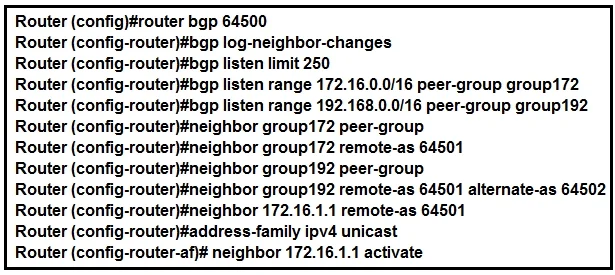
Refer to the exhibit. After creating dynamic neighbors for the range specified, the network administrator with an employee ID: 4698:80:283 cannot see all the BGP neighbors established. What is the…
The correct answer is C. The peer groups must also be activated inside the address family. BGP dynamic neighbor (listen range) feature allows a router to accept BGP sessions from any peer within a defined IP prefix range, associating them with a peer group. However, simply defining the listen range and associating it with a peer group under the global BGP…
Question
Refer to the exhibit. After creating dynamic neighbors for the range specified, the network administrator with an employee ID: 4698:80:283 cannot see all the BGP neighbors established. What is the issue?
Exhibit
Options
- AA list of neighbors belongs only to a defined ASN.
- BThe listen limit is smaller than the prefix defined in the listen range.
- CThe peer groups must also be activated inside the address family.
- DThe single activated neighbor cannot be within the listen range.
How the community answered
(28 responses)- A14% (4)
- B11% (3)
- C71% (20)
- D4% (1)
Explanation
BGP dynamic neighbor (listen range) feature allows a router to accept BGP sessions from any peer within a defined IP prefix range, associating them with a peer group. However, simply defining the listen range and associating it with a peer group under the global BGP configuration is not sufficient. The peer group must also be explicitly activated inside each relevant address family (e.g., 'address-family ipv4' or 'address-family vpnv4') using the 'neighbor <peer-group-name> activate' command. Without this activation in the address family, BGP will not negotiate and exchange prefixes for that address family, so sessions may not fully establish or routes may not be exchanged. Option A is incorrect because dynamic neighbors can span multiple ASNs. Option B is incorrect because the listen limit controls the maximum number of dynamic peers, not whether sessions are established. Option D is incorrect because a manually configured neighbor can coexist within a listen range.
Topics
Community Discussion
No community discussion yet for this question.