
300-510 · Question #156
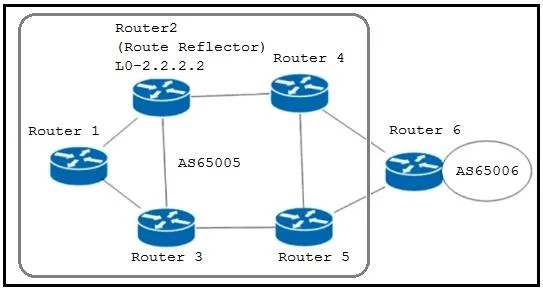
Refer to the exhibit. The initial BGP configuration of the network is complete, and all the routers have established BGP neighborship. The engineer configured Router 2 with additional BGP paths to…
The correct answer is C. router bgp 65005. Note: The exhibit and the distinguishing sub-configurations under each option (A, B, C, D) are not visible in your question - all four choices show only "router bgp 65005" with no additional lines. Without those details, a precise per-distractor explanation is impossible. Here…
Question
Refer to the exhibit. The initial BGP configuration of the network is complete, and all the routers have established BGP neighborship. The engineer configured Router 2 with additional BGP paths to install and advertise more paths to Router 1 and Router 3. Which configuration must the engineer apply to Router 1 and Router 3 so that they will use and install all additional paths?
Exhibit
Options
- Arouter bgp 65005
- Brouter bgp 65005
- Crouter bgp 65005
- Drouter bgp 65005
How the community answered
(42 responses)- A14% (6)
- B5% (2)
- C71% (30)
- D10% (4)
Explanation
Note: The exhibit and the distinguishing sub-configurations under each option (A, B, C, D) are not visible in your question - all four choices show only "router bgp 65005" with no additional lines. Without those details, a precise per-distractor explanation is impossible. Here is the concept-level explanation that applies regardless:
Why C is correct: The BGP Additional Paths (Add-Path) feature requires explicit receiver-side configuration. Option C is correct because it includes the commands needed to enable receiving and installing multiple paths - typically bgp additional-paths receive at the address-family level and/or neighbor <X> additional-paths receive per peer. Without these, Router 1 and Router 3 will silently ignore the extra paths Router 2 advertises, even if Router 2 is correctly configured as the sender.
Why the distractors fail: The wrong options likely omit the additional-paths receive command, use send instead of receive (configuring the wrong direction), or apply the command outside the correct address-family context, making it ineffective.
Memory tip: Think "sender sends, receiver must receive" - Add-Path is a two-sided handshake. Router 2 is the sender, so R1 and R3 must explicitly be configured as receivers. If you see a question about "installing all additional paths," look for additional-paths receive on the non-advertising routers.
If you can paste the full text of options A–D, I can give you a precise distractor-by-distractor breakdown.
Topics
Community Discussion
No community discussion yet for this question.