
300-510 · Question #155
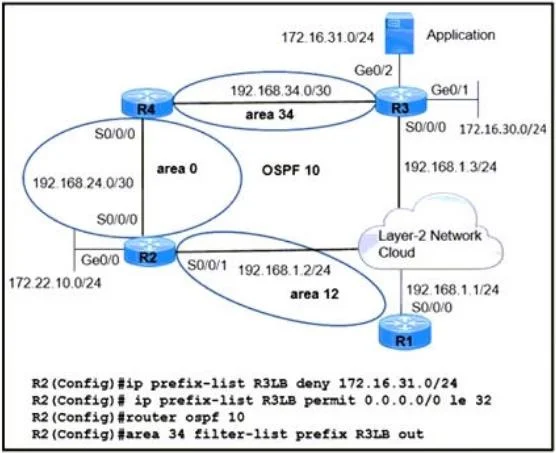
Refer to the exhibit. Networks 172.16.31.0/24 and 172.16.30.0/24 are advertised in area 34, and network 172.22.10.0/24 is advertised in area 0. A recent security review discovered that users…
The correct answer is D. Apply route filtering on router R4 only. Applying the filter on R4 alone is correct because R4 is the sole ABR (Area Border Router) connecting Area 34 to Area 0. Since inter-area routes must pass through the ABR to reach Area 0, filtering 172.16.31.0/24 on R4's outbound advertisements completely prevents R1 and R2…
Question
Refer to the exhibit. Networks 172.16.31.0/24 and 172.16.30.0/24 are advertised in area 34, and network 172.22.10.0/24 is advertised in area 0. A recent security review discovered that users connected to routers R1 and R2 have been making unauthorized access to an application running on network 172.16.31.0/24. An engineer determined that routers R1 and R2 are receiving updates for network 17.16.31.0/24. Which action resolves the issue?
Exhibit
Options
- AApply route filtering on routers R3 and R4.
- BApply route filtering on router R3 only.
- CApply route filtering on routers R1 and R2
- DApply route filtering on router R4 only.
How the community answered
(61 responses)- A13% (8)
- B25% (15)
- C7% (4)
- D56% (34)
Explanation
Applying the filter on R4 alone is correct because R4 is the sole ABR (Area Border Router) connecting Area 34 to Area 0. Since inter-area routes must pass through the ABR to reach Area 0, filtering 172.16.31.0/24 on R4's outbound advertisements completely prevents R1 and R2 from ever learning the route - stopping unauthorized access at the source.
Why the distractors are wrong:
- A (R3 and R4): R3 is an internal router within Area 34, not an ABR into Area 0, so filtering there has no effect on what R1 and R2 receive. Filtering on R4 alone is sufficient.
- B (R3 only): Same problem - R3 doesn't advertise into Area 0, so this does nothing to protect against R1/R2 receiving the route via R4.
- C (R1 and R2): While this could prevent R1/R2 from using the route, it's the wrong place to filter - the route still propagates through Area 0, and you'd need to repeat the configuration on every new router added. ABR filtering is the architecturally correct solution.
Memory tip: Think "filter at the gate, not at every door." In OSPF, the ABR is the gateway between areas - always filter there to control what enters or exits an area, rather than chasing the problem downstream at each individual router.
Topics
Community Discussion
No community discussion yet for this question.