
PL-200 · Question #305
Drag and Drop Question You are creating Power Automate automations targeting Dataverse. The automations must meet the following requirements: - Run a custom API created by a developer. The API…
The correct answer is Perform a bound action.; Perform an unbound action.; Perform a changeset request.; Perform an unbound action. This question tests the ability to correctly match Power Automate Dataverse connector actions with specific automation requirements, focusing on transactional operations and custom API invocations.
Question
Exhibit
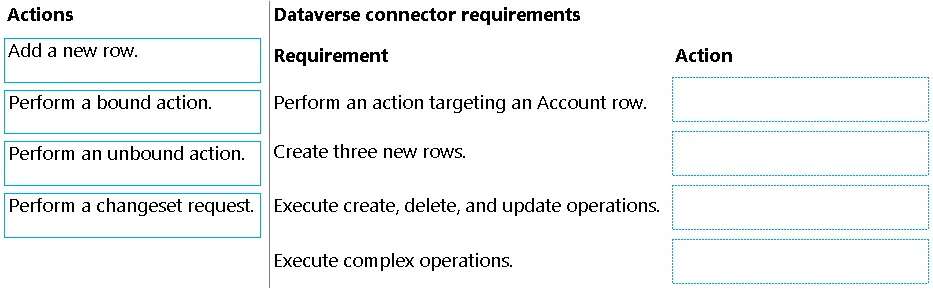
Answer Area
Drag items
Correct arrangement
- Perform a bound action.
- Perform an unbound action.
- Perform a changeset request.
- Perform an unbound action.
Explanation
This question tests the ability to correctly match Power Automate Dataverse connector actions with specific automation requirements, focusing on transactional operations and custom API invocations.
Approach. To answer correctly, each requirement must be matched with the Dataverse connector action that best fulfills its specific criteria:
-
Requirement: 'Run a custom API created by a developer. The API performs an action against an existing Account row in the system.'
- Correct Action: 'Perform a bound action.'
- Reasoning: Bound actions in Dataverse are operations that are defined on a specific entity type (e.g., 'Account') and operate on an instance (row) of that entity. This precisely matches the scenario of an action targeting an 'existing Account row'.
-
Requirement: 'Create three rows in Dataverse. If an error occurs when you create the second row, the first row must be deleted.'
- Correct Action: 'Perform an unbound action.'
- Reasoning: This requirement describes a custom transactional logic for creating multiple rows with a specific rollback mechanism. Unlike Requirement 3, it does not explicitly state 'without writing custom code'. This implies that this specific, potentially complex, transactional creation logic is handled by a custom API. An 'unbound action' is used to invoke a global custom API that can encapsulate such specific business rules and transactional behavior across multiple records, not tied to a specific entity context for its invocation.
-
Requirement: 'Run several create, update, and delete operations as part of a single transaction without writing custom code.'
- Correct Action: 'Perform a changeset request.'
- Reasoning: A 'changeset request' is specifically designed in Power Automate and Dataverse (using OData batch requests) to group multiple create, update, and delete operations into an atomic transaction. If any operation within the changeset fails, all prior operations in that changeset are rolled back, ensuring data consistency. The phrase 'without writing custom code' explicitly guides towards using this native Power Automate capability.
-
Requirement: 'Run several complex operations targeting multiple rows in the system as part of a single transaction.'
- Correct Action: 'Perform an unbound action.'
- Reasoning: 'Complex operations' implies logic beyond simple create/update/delete. An 'unbound action' is used to invoke a global custom API or a predefined Dataverse action that can encapsulate sophisticated business logic, potentially affecting multiple records. While 'single transaction' is mentioned, the emphasis on 'complex operations' indicates that the overall execution of this complex logic (often within a custom API) needs to be transactional, and the custom API would handle its internal transaction scope. This is distinct from a changeset which primarily groups basic CRUD operations.
Common mistakes.
- common_mistake. A common mistake is misinterpreting the specific nuances of 'transactional operations' and 'custom APIs'. For Requirement 2 ('Create three new rows... If an error occurs...'), incorrectly choosing 'Perform a changeset request' would be wrong if the intention is to signify a custom transactional process that isn't purely simple CUD via native Power Automate without code. While a changeset does provide transactional behavior, the absence of 'without writing custom code' in Requirement 2, contrasted with its presence in Requirement 3, suggests that a custom API (unbound action) is the intended solution for the specific logic described. For Requirement 3 ('Run several create, update, and delete operations as part of a single transaction without writing custom code'), incorrectly choosing 'Add a new row' is wrong because it only creates a single row and doesn't provide transactional rollback. Choosing 'Perform an unbound action' here would also be incorrect because the requirement explicitly states 'without writing custom code', directly pointing to the native 'changeset request' functionality. For Requirement 4 ('Run several complex operations...'), using 'Perform a changeset request' would be wrong because changesets are primarily for grouping basic CUD operations, not 'complex operations' which typically involve custom logic best encapsulated in an unbound action/API.
Concept tested. This question tests the understanding of different Dataverse connector actions in Power Automate, specifically: bound actions for entity-specific operations, unbound actions for global or custom API-driven complex logic, and changeset requests for transactional grouping of create, update, and delete operations, as well as the distinction between native Power Automate capabilities and custom code implementation.
Topics
Community Discussion
No community discussion yet for this question.