
PK0-004 · Question #681
A company has decided to bring in outside consultants to assist with the risks that have the greatest effects. The consultants will take ownership of those risks and will be contractually liable if…
The correct answer is B. 1, 2, 5. Risk effect (or exposure) is calculated by multiplying Probability × Impact. The table referenced in the exam question provides values for each numbered risk; when those calculations are performed, Risks 1, 2, and 5 produce the highest combined scores, making them the…
Question
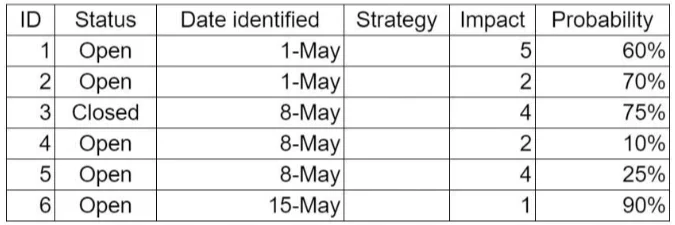
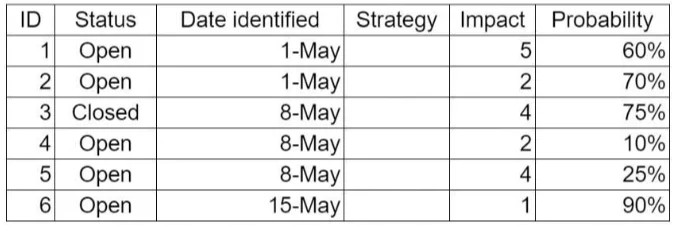
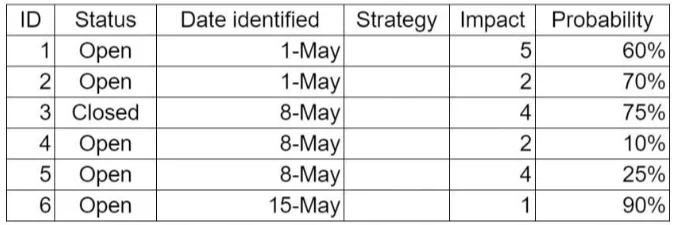
A company has decided to bring in outside consultants to assist with the risks that have the greatest effects. The consultants will take ownership of those risks and will be contractually liable if the impact is greater than a predetermined cost value. Given the information in the table below:
Which of the following risks have the GREATEST effect?
Exhibits
Options
- A1, 2, 3
- B1, 2, 5
- C1, 3, 5
- D2, 4, 6
- E4, 5, 6
How the community answered
(37 responses)- A3% (1)
- B57% (21)
- C22% (8)
- D11% (4)
- E8% (3)
Explanation
Risk effect (or exposure) is calculated by multiplying Probability × Impact. The table referenced in the exam question provides values for each numbered risk; when those calculations are performed, Risks 1, 2, and 5 produce the highest combined scores, making them the highest-priority risks for transfer to the external consultants. This scenario describes risk transference - a risk response strategy where ownership and financial liability for a risk is shifted to a third party (here, the consultants), which is appropriate when the risk impact can be quantified and contractually bounded. Always rank risks by their probability-impact product to identify which to transfer, avoid, mitigate, or accept.
Topics
Community Discussion
No community discussion yet for this question.