
MS-900 · Question #79
Hotspot Question You manage point-of-sale terminals that run Windows 7. You must upgrade the terminals to Windows 10. Terminals will not be upgraded again for at least five years. You have the…
To meet the requirements of long-term stability for point-of-sale terminals, minimize costs, and ensure consistent update scheduling, the solution is to use Windows 10 Enterprise LTSC with the Long-term servicing channel, managed by Windows Server Update Services (WSUS).
Question
Exhibit
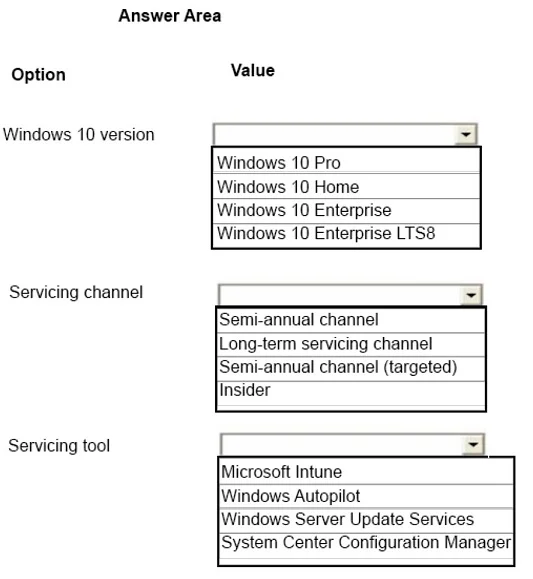
Answer Area
- Windows 10 versionWindows 10 ProWindows 10 HomeWindows 10 EnterpriseWindows 10 Enterprise LTS8
- Servicing channelSemi-annual channelLong-term servicing channelSemi-annual channel (targeted)Insider
- Servicing toolMicrosoft IntuneWindows AutopilotWindows Server Update ServicesSystem Center Configuration Manager
Explanation
To meet the requirements of long-term stability for point-of-sale terminals, minimize costs, and ensure consistent update scheduling, the solution is to use Windows 10 Enterprise LTSC with the Long-term servicing channel, managed by Windows Server Update Services (WSUS).
Approach. The correct interaction involves selecting the following options from the dropdown menus:
-
Windows 10 version: Select 'Windows 10 Enterprise LTS8' (Long-Term Servicing Channel/Branch - LTSC/LTSB).
- Reasoning: The requirement states terminals 'will not be upgraded again for at least five years' and are 'point-of-sale terminals'. Windows 10 Enterprise LTSC (Long-Term Servicing Channel) is specifically designed for specialized devices like POS terminals that require maximum stability, do not need frequent feature updates, and receive only security and critical updates for an extended period (typically 10 years). This perfectly aligns with the long-term stability requirement.
-
Servicing channel: Select 'Long-term servicing channel'.
- Reasoning: This servicing channel directly corresponds to the Windows 10 Enterprise LTSC version. It provides infrequent updates, focusing on security and critical fixes, ensuring the stability required for devices that will not be upgraded for many years, thus meeting the 'at least five years' requirement.
-
Servicing tool: Select 'Windows Server Update Services'.
- Reasoning: The requirements include 'minimize costs' and 'perform consistent scheduling of upgrades across all devices'. WSUS is a free (included with Windows Server licenses) on-premises solution that allows administrators to manage and distribute Microsoft product updates to computers on a network. It provides centralized control and scheduling of updates at no additional software cost, perfectly fulfilling the cost minimization and consistent scheduling needs for a Windows-based environment.
Common mistakes.
- common_mistake. Several other choices would be incorrect:
- Windows 10 Pro/Home/Enterprise (non-LTSC) with Semi-annual channel: These versions and channels receive feature updates twice a year. This contradicts the requirement for devices 'not to be upgraded again for at least five years' and the need for maximum stability for POS systems, which would be disrupted by frequent feature updates.
- Semi-annual channel (targeted) or Insider: These channels are for faster adoption of new features or testing, respectively, and are completely unsuitable for critical POS systems requiring long-term stability and minimal disruption.
- Microsoft Intune as Servicing tool: While Intune can manage Windows updates, it is a cloud-based service that requires subscription licenses, which would incur additional costs, contradicting the 'minimize costs' requirement. It's also typically used for broader mobile device and application management.
- Windows Autopilot as Servicing tool: Autopilot is primarily used for deploying and provisioning new devices with pre-configured settings. It is not an update management solution for ongoing patching and servicing.
- System Center Configuration Manager (SCCM) as Servicing tool: SCCM is a comprehensive endpoint management solution. While it can manage updates and provide consistent scheduling, it typically involves significant licensing costs and infrastructure, making it a more expensive solution than WSUS and thus failing the 'minimize costs' requirement, especially if its full capabilities are not needed.
Concept tested. This question tests the understanding of:
- Windows as a Service (WaaS) servicing channels: Differentiating between the Semi-Annual Channel (SAC) and the Long-Term Servicing Channel (LTSC).
- Windows 10 Editions: Knowing the specific use cases and benefits of Windows 10 Enterprise LTSC for specialized, fixed-function devices.
- Windows Update Management Tools: Comparing the capabilities, costs, and suitability of various tools like Windows Server Update Services (WSUS), Microsoft Intune, Windows Autopilot, and System Center Configuration Manager (SCCM) for deploying and managing updates in an enterprise environment.
Topics
Community Discussion
No community discussion yet for this question.