
MS-721 · Question #83
Drag and Drop Question You have a Microsoft Teams Phone deployment. You need to configure voice routing for Direct Routing. The solution must only allow calling within the United States and Canada…
The correct answer is Add a PSTN usage record named Record1; Create a voice route that has a dialed number pattern of "^\+\1(425)\d{7}$"; Add a voice routing policy; Assign a voice routing policy. To configure Direct Routing for Teams Phone, allowing calls only within the United States and Canada for a specific user, the correct sequence involves creating foundational components like PSTN usage records and voice routes, then grouping them into a voice routing policy, and…
Question
Exhibit
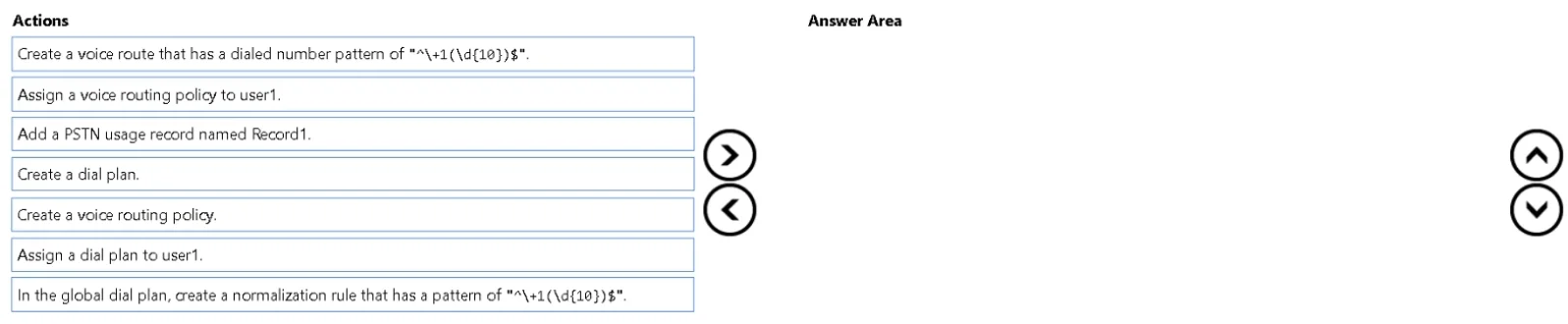
Answer Area
Drag items
Correct arrangement
- Add a PSTN usage record named Record1
- Create a voice route that has a dialed number pattern of "^+\1(425)\d{7}$"
- Add a voice routing policy
- Assign a voice routing policy
Explanation
To configure Direct Routing for Teams Phone, allowing calls only within the United States and Canada for a specific user, the correct sequence involves creating foundational components like PSTN usage records and voice routes, then grouping them into a voice routing policy, and finally assigning that policy to the user.
Approach. The correct approach involves configuring the necessary components in a logical order that builds upon previous steps and minimizes user disruption, as specified in the question. The four correct actions and their sequence are:
-
Add a PSTN usage record named Record1.
- Reason: PSTN usage records are essentially labels or tags that link voice routes to voice routing policies. They are foundational elements that must exist before they can be referenced by voice routes or policies. This specific record ('Record1') will be used to signify the allowed usage for US/Canada calling.
-
Create a voice route that has a dialed number pattern of "^\+1\d{10}$".
- Reason: A voice route defines specific number patterns (using regular expressions) that are allowed to be dialed. The pattern
^\+1\d{10}$precisely matches E.164 formatted numbers for North America (a '+1' prefix followed by exactly 10 digits). This route specifies which numbers can be called and typically links to a Session Border Controller (SBC, though not an explicit action here) and a PSTN usage record (Record1).
- Reason: A voice route defines specific number patterns (using regular expressions) that are allowed to be dialed. The pattern
-
Create a voice routing policy.
- Reason: A voice routing policy is a collection of one or more PSTN usage records. It acts as a container that groups allowed calling functionalities. This policy will include 'Record1', thus linking the user to the allowed voice route configured in the previous step.
-
Assign a voice routing policy to user1.
- Reason: This is the final step to apply the entire configuration to the target user (
user1). By assigning the policy, the calling restrictions and routing logic defined in the voice route and PSTN usage record are enforced for that user. Performing this action last ensures that all underlying components are fully configured before the policy takes effect, thereby minimizing any potential call disruption for the user.
- Reason: This is the final step to apply the entire configuration to the target user (
Common mistakes.
- common_mistake. Common mistakes include incorrectly choosing actions related to dial plans, such as 'Create a dial plan.', 'Assign a dial plan to user1.', or 'In the global dial plan, create a normalization rule that has a pattern of "^\+1\d{10}$".'. While dial plans and normalization rules are crucial for ensuring numbers are converted into the E.164 format before routing, the core requirement here is to limit calls to specific regions using Direct Routing's outbound call control mechanisms. This restriction is primarily handled by PSTN usage records, voice routes, and voice routing policies. Dial plans are for normalization (how numbers are interpreted internally), not for restriction (which numbers can actually be dialed out) in this specific context. Including these actions would be incorrect because they do not directly address the requirement of allowing calling only within the United States and Canada via Direct Routing's outbound policies, and they are not part of the minimum four actions to achieve this specific goal.
Concept tested. Microsoft Teams Phone Direct Routing configuration, specifically outbound voice routing, PSTN usage records, voice routes, and voice routing policies. It also tests the understanding of the correct sequence and dependencies of these components.
Topics
Community Discussion
No community discussion yet for this question.