
MS-721 · Question #82
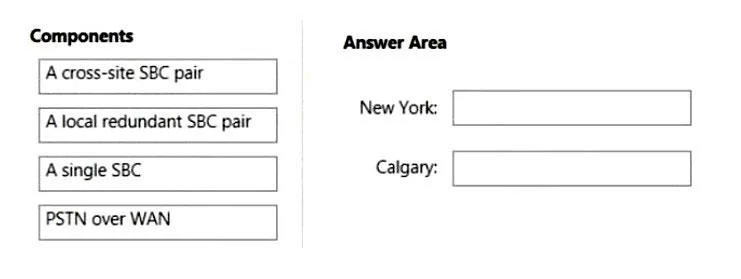
Drag and Drop Question Your company has a main office in New York and a branch office in Calgary. All offices connect to each other by using a dedicated WAN. You have a Microsoft Teams Phone…
The correct answer is A local redundant SBC pair; A cross-site SBC pair. The company needs local PSTN egress with redundancy for New York and efficient cross-site redundancy for Calgary, minimizing SBCs. A local redundant SBC pair in New York provides high availability. A cross-site SBC pair solution for Calgary, typically involving a single local…
Question
Exhibit
Answer Area
Drag items
Correct arrangement
- A local redundant SBC pair
- A cross-site SBC pair
Explanation
The company needs local PSTN egress with redundancy for New York and efficient cross-site redundancy for Calgary, minimizing SBCs. A local redundant SBC pair in New York provides high availability. A cross-site SBC pair solution for Calgary, typically involving a single local SBC with failover to New York's redundant pair, balances local egress priority and availability while minimizing SBC count.
Approach. For New York, the requirement states, 'If a Session Border Controller (SBC) fails in the New York office, PSTN services must remain available through a local PSTN egress in New York.' This explicitly calls for local redundancy to ensure continuous service from the local PSTN egress in case of an SBC failure. Therefore, 'A local redundant SBC pair' (two SBCs deployed in New York for high availability) is the direct and most appropriate solution.
For Calgary, the requirements are to 'prioritize a local PSTN egress' and 'ensure that PSTN services remain available in the event of a local SBC outage,' all while minimizing the number of SBCs. To prioritize local egress, Calgary needs at least one local SBC. To ensure availability during a local SBC outage and minimize SBCs, the most efficient solution is to have a single local SBC that, in case of failure, routes PSTN traffic over the dedicated WAN to the redundant SBC pair in the New York office. This is a common 'cross-site resiliency' or 'centralized failover' model. The option 'A cross-site SBC pair' is the best description for this overall solution for Calgary, as its resilience is provided by a pair of SBCs (the New York pair) that are accessible across sites. This minimizes Calgary's local SBC count to one while leveraging existing infrastructure in New York.
Common mistakes.
- common_mistake. - Calgary - A local redundant SBC pair: While this would provide local redundancy for Calgary, it would mean deploying two SBCs in Calgary. Combined with the two SBCs in New York, this would total four SBCs. This solution does not meet the 'minimize the number of SBCs' requirement as effectively as a single SBC in Calgary failing over to New York's redundant pair (totaling three SBCs).
- Calgary - A single SBC: While Calgary would indeed have a single local SBC for primary egress, this option alone does not fully describe the redundancy solution ('ensure that PSTN services remain available in the event of a local SBC outage'). The question asks for the recommended solution for the office, which implies including the resiliency aspect. The 'cross-site SBC pair' option better describes the complete resilient architecture for Calgary.
- New York - A single SBC: This option would not meet the requirement for PSTN services to remain available through local egress in New York if an SBC fails. A single SBC offers no local redundancy.
- PSTN over WAN (for either office): This option describes a method of traffic routing, not an SBC component or a complete solution for an office's Direct Routing setup. It also explicitly contradicts Calgary's requirement to 'prioritize a local PSTN egress' if it were the sole solution for Calgary.
Concept tested. The core concept tested is the understanding of Microsoft Teams Direct Routing architecture, specifically Session Border Controller (SBC) deployment strategies for high availability and branch office resiliency, including local redundancy and cross-site failover, while also considering cost optimization (minimizing SBCs).
Topics
Community Discussion
No community discussion yet for this question.