MB-800 · Question #266
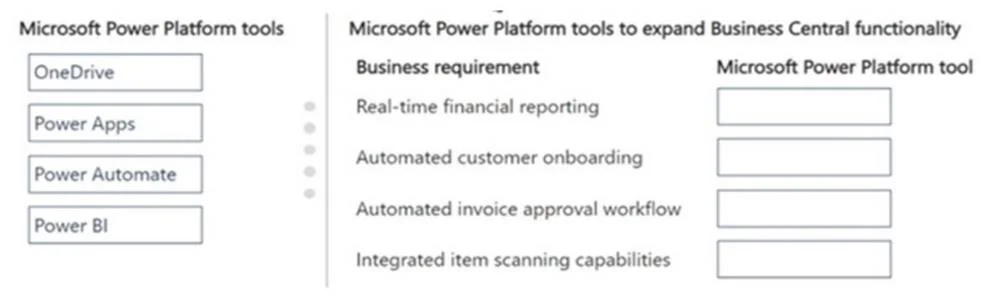
Drag and Drop Question A company is implementing Business Central. The company is evaluating Microsoft Power Platform integration benefits. The company has the following business requirements…
The correct answer is Power BI; Power Automate; Power Automate; Power Apps. Microsoft Power Platform - Business Central Integration Requirements to Tool Mapping | # | Business Requirement | Tool | |---|---|---| | 1 | Real-time financial reporting | Power BI | | 2 | Automate customer onboarding | Power Automate | | 3 | Automate invoice approvals | Power…
Question
Exhibit
Answer Area
Drag items
Correct arrangement
- Power BI
- Power Automate
- Power Automate
- Power Apps
Explanation
Microsoft Power Platform - Business Central Integration
Requirements to Tool Mapping
| # | Business Requirement | Tool |
|---|---|---|
| 1 | Real-time financial reporting | Power BI |
| 2 | Automate customer onboarding | Power Automate |
| 3 | Automate invoice approvals | Power Automate |
| 4 | Item scanning in warehouse | Power Apps |
Placement Explanations
1. Real-time financial reporting → Power BI
Power BI is Microsoft's dedicated business analytics and data visualization platform. It connects natively to Business Central via a certified connector, enabling live dashboards and financial reports that refresh in real time. No other Power Platform tool is designed for this purpose - Power Apps can display data but is not a reporting/analytics engine.
2. Automate customer onboarding → Power Automate
Customer onboarding involves a sequence of triggered steps: creating records, sending welcome emails, provisioning access, notifying teams. Power Automate (formerly Microsoft Flow) is built exactly for multi-step process automation triggered by events (e.g., "new customer record created in Business Central"). It has pre-built Business Central connectors for this.
3. Automate invoice approval workflow → Power Automate
Invoice approval is a classic workflow automation scenario - route a document to an approver, wait for a response, then act on approval/rejection. Power Automate has a built-in Approvals action and direct Business Central connectors, making it the right tool. This is the same tool as #2 because both requirements describe workflow automation, and the question states tools can be used more than once.
4. Warehouse item scanning → Power Apps
Power Apps lets you build custom mobile applications without heavy development. It includes a native Barcode Scanner control, making it ideal for building a warehouse scanning app that runs on tablets/phones. Warehouse workers can scan items and interact with Business Central data through the app in real time.
Common Mistakes
- Power Automate vs Power Apps confusion: Automate = workflows between systems; Apps = user-facing custom applications. Scanning requires a UI → Apps. Approval routing requires no custom UI → Automate.
- OneDrive as a distractor: OneDrive is file cloud storage, not a Power Platform automation or analytics tool. It appears here to test whether you recognize it doesn't solve any of these requirements.
- Power BI for onboarding/approvals: Power BI is read-only reporting. It cannot trigger actions or automate processes.
- Using Power Apps for reporting: Power Apps can show data in a form/gallery but is not a substitute for Power BI's analytical, aggregation, and visualization capabilities.
Topics
Community Discussion
No community discussion yet for this question.