MB-800 · Question #239
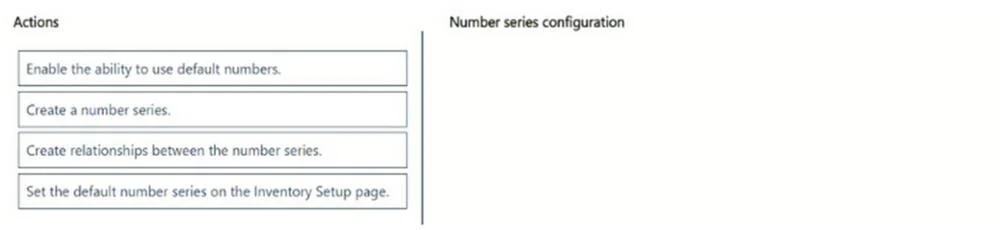
Drag and Drop Question A manufacturer uses Dynamics 365 Business Central. The company has the following item types: - Raw Materials - Work-in-progress (WIP) - Finished Goods Different prefixes are…
The correct answer is Enable the ability to use default numbers.; Create a number series.; Create relationships between the number series.; Set the default number series on the Inventory Setup page. Dynamics 365 Business Central: Number Series Configuration Order The correct order reflects a dependency chain - each step requires the previous one to exist before it can be configured. --- Step 1: Enable the ability to use default numbers Technical reason: This is a…
Question
Exhibit
Answer Area
Drag items
Correct arrangement
- Enable the ability to use default numbers.
- Create a number series.
- Create relationships between the number series.
- Set the default number series on the Inventory Setup page.
Explanation
Dynamics 365 Business Central: Number Series Configuration Order
The correct order reflects a dependency chain - each step requires the previous one to exist before it can be configured.
Step 1: Enable the ability to use default numbers
Technical reason: This is a prerequisite gate. In Business Central, the option to use default (automatic) number assignment must be enabled at the application level before any number series can leverage it. Without this, the "Default Nos." toggle on individual number series has no effect. You're unlocking the feature before building on top of it.
Common mistake: People skip this step assuming automatic numbering is on by default. It isn't - and the symptom is that later steps appear to work but automatic assignment silently fails.
Step 2: Create a number series
Technical reason: You must have the number series objects themselves before you can relate them or assign them anywhere. Each item type (Raw Materials, WIP, Finished Goods) needs its own series with its own prefix (e.g., RM-, WIP-, FG-). Setting "Default Nos." and "Manual Nos." flags here also requires Step 1 to already be enabled.
Common mistake: Creating only one series for all item types. The requirement explicitly states unique series per type.
Step 3: Create relationships between the number series
Technical reason: Relationships allow a user to choose from multiple series when creating an item manually - satisfying the "selectable when creating manual items" requirement. Relationships link series together so the selection list appears at the document/item card level. This step only makes sense after the individual series exist (Step 2).
Common mistake: Thinking relationships are optional because automatic numbering is set up. They're required specifically to support the manual selection requirement.
Step 4: Set the default number series on the Inventory Setup page
Technical reason: This is where you tell Business Central which series to use as the default for the Item table. The Inventory Setup page holds the No. Series field for items - it can only point to series that already exist and are already related. This step is last because it consumes everything built in Steps 1–3.
Common mistake: Trying to set this first. The field will either be blank (nothing to select) or the related series won't appear in the lookup yet.
Why "more than one correct order" is noted
Steps 1 and 2 could arguably be swapped in a UI sense (you can create a series before enabling defaults), but Step 1 must be done before the "Default Nos." flag on a series is meaningful. The examiners acknowledge minor reorderings may be valid - the core constraint is that series must exist before relationships, and relationships before Inventory Setup assignment.
Topics
Community Discussion
No community discussion yet for this question.