
MB-500 · Question #388
You create a custom payroll form. You must ensure that only the finance manager can view the form. You need to set up security for the form. Which three actions should you perform? Each correct…
The correct answer is A. Add the privilege to a new duty. D. Add the duty to the security role for finance managers. E. Add the menu item of the form to the entry point of a new privilege. E: In the security model, a privilege specifies the level of access that is required to perform a job, solve a problem, or complete an assignment. Privileges can be assigned directly to roles, however we recommend that you only assign duties to roles. A: In the security model…
Question
Exhibit
Options
- AAdd the privilege to a new duty.
- BAdd the duty to the security role of system users.
- CAdd the privilege to a new security policy.
- DAdd the duty to the security role for finance managers.
- EAdd the menu item of the form to the entry point of a new privilege.
How the community answered
(32 responses)- A75% (24)
- B6% (2)
- C19% (6)
Explanation
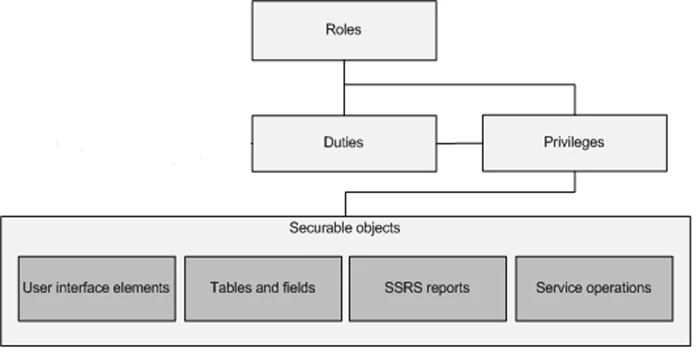
E: In the security model, a privilege specifies the level of access that is required to perform a job, solve a problem, or complete an assignment. Privileges can be assigned directly to roles, however we recommend that you only assign duties to roles. A: In the security model, duties contain privileges. D (not B): All users must be assigned to at least one security role in order to have access to finance and operations. The security roles that are assigned to a user determine the duties that the user can perform and the parts of the user interface that the user can view. Duties correspond to parts of a business process. The administrator assigns duties to security Not C: Security policies are not used to set up permissions. In role-based security, access is not granted to individual users, only to security roles. Users are assigned to roles. A user who is assigned to a security role has access to the set of privileges that is associated with that role. A user who is not assigned to any role has no privileges. Overview of role-based security Permissions represent access to individual securable objects, such as menu items and tables. Privileges are composed of permissions and represent access to tasks, such as canceling payments and processing deposits. Duties are composed of privileges and represent parts of a business process, such as maintaining bank transactions. Both duties and privileges can be assigned to roles to grant access to finance and operations. The following illustration shows the elements of role-based security and their relationships. https://docs.microsoft.com/en-us/dynamics365/fin-ops-core/dev-itpro/sysadmin/role-based-
Topics
Community Discussion
No community discussion yet for this question.