
AZ-400 · Question #201
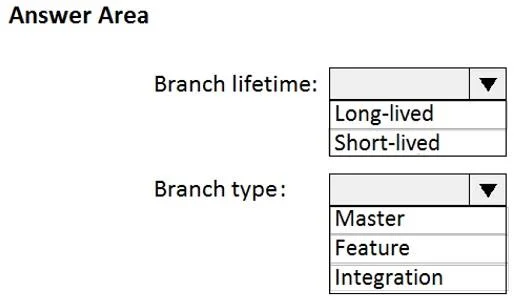
Hotspot Question Your company uses Git as a source code control system for a complex app named App1. You plan to add a new functionality to App1. You need to design a branching model for the new…
This question tests knowledge of Git branching strategies, specifically the appropriate branch lifetime and branch type when adding new functionality to an existing application.
Question
Exhibit
Answer Area
- Branch lifetime:Long-livedShort-lived
- Branch type:MasterFeatureIntegration
Explanation
This question tests knowledge of Git branching strategies, specifically the appropriate branch lifetime and branch type when adding new functionality to an existing application.
Approach. For adding new functionality, you should use a short-lived branch lifetime combined with a feature branch type. A feature branch is specifically designed for developing new functionality in isolation from the main codebase, allowing parallel development without disrupting stable code. Short-lived branches are preferred in modern DevOps practices (e.g., trunk-based development, GitFlow) because they reduce merge conflicts, enable faster integration, and align with continuous integration principles - the branch exists only for the duration of the feature development and is merged back once complete.
Concept tested. Git branching strategies for new feature development, specifically understanding branch types (feature, release, hotfix, main/trunk) and branch lifetimes (short-lived vs. long-lived) in the context of DevOps and Azure DevOps best practices.
Reference. Microsoft Learn - Adopt a Git branching strategy: https://learn.microsoft.com/en-us/azure/devops/repos/git/git-branching-guidance
Topics
Community Discussion
No community discussion yet for this question.