
AZ-104 · Question #230
Case Study 4 - ADatum Overview ADatum Corporation is a financial company that has two main offices in New York and Los Angeles. ADatum has a subsidiary named Fabrikam, Inc. that shares the Los…
The correct answer is Use BGP to append the private AS numbers to the advertised prefixes.; Use BGP communities to configure BGP's Local Preference. ExpressRoute Routing Configuration - Explanation The Core Problem ADatum needs two-circuit routing with regional preference and automatic failover: ER1 (New York) -> primary for East US PaaS traffic ER2 (Los Angeles) -> primary for West US PaaS traffic Both circuits must fail…
Question
Exhibit
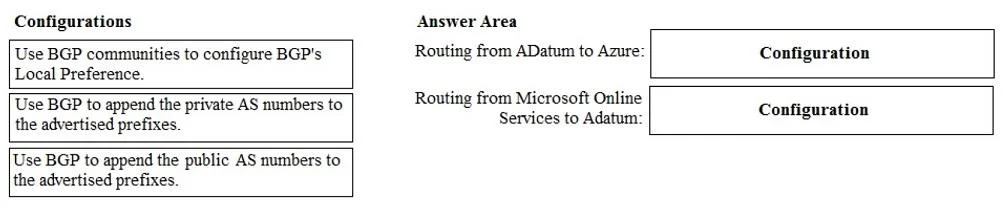
Answer Area
Drag items
Correct arrangement
- Use BGP to append the private AS numbers to the advertised prefixes.
- Use BGP communities to configure BGP's Local Preference.
Explanation
ExpressRoute Routing Configuration - Explanation
The Core Problem
ADatum needs two-circuit routing with regional preference and automatic failover:
- ER1 (New York) -> primary for East US PaaS traffic
- ER2 (Los Angeles) -> primary for West US PaaS traffic
- Both circuits must fail over automatically when the other is unavailable
Two BGP mechanisms are needed - one for each traffic direction.
Correct Arrangement & Why
Slot 1 - AS Path Prepending (private AS numbers)
"Use BGP to prepend the private AS numbers to the advertised prefixes."
Direction: On-premises -> Azure (outbound from customer)
This controls how Microsoft routes return traffic back to ADatum's on-premises network. When ADatum advertises its prefixes to Microsoft over both circuits, prepending extra private AS numbers on the non-preferred circuit makes that AS path artificially longer. BGP always prefers shorter paths, so Microsoft will route return traffic via the primary circuit.
- ER1 advertises NY prefixes to Microsoft without prepending -> preferred (shorter path)
- ER2 advertises the same NY prefixes with AS prepending -> backup (longer path)
When ER1 fails, Microsoft automatically falls back to ER2 since it's the only remaining path - this is how automatic failover is achieved.
Note on terminology: The available option says "prepend" and the correct answer says "append" - these refer to the same BGP AS Path Prepending technique. "Prepend" is the standard industry term (you prepend your AS number to the front of the AS_PATH attribute). This appears to be a terminology inconsistency in the question itself.
Slot 2 - BGP Communities + Local Preference
"Use BGP communities to configure BGP's Local Preference."
Direction: Azure -> On-premises (inbound from customer's perspective, i.e., choosing which circuit to use to reach PaaS)
Microsoft tags its advertised PaaS prefixes with BGP communities indicating the Azure region (e.g., East US, West US). ADatum's edge routers read these communities and set Local Preference accordingly:
- Routes tagged with East US community received on ER1 -> high Local Preference -> NY office uses ER1
- Routes tagged with West US community received on ER2 -> high Local Preference -> LA office uses ER2
When a circuit fails, BGP withdraws those routes and the router automatically uses the remaining circuit - automatic failover again.
Why the Third Option Is Wrong
"Use BGP to append the public AS numbers to the advertised prefixes."
With Microsoft peering, public AS numbers are used in the BGP session itself (you use a public ASN or a Microsoft-assigned one). Appending public AS numbers to advertised prefixes is not a valid or supported technique for influencing route preference in this context - and could cause routing policy violations. Private AS numbers used in prepending are stripped at Microsoft's edge and don't propagate into the public internet.
Common Mistakes
| Mistake | Why It's Wrong |
|---|---|
| Using only Local Preference | Controls only outbound direction; doesn't influence how Microsoft sends return traffic |
| Using only AS prepending | Controls only return path; you still need to control which circuit your own routers prefer for reaching PaaS |
| Confusing "prepend/append" terminology | Both mean AS Path Prepending in this context - the question has inconsistent wording |
| Using public AS numbers for prepending | Public ASNs are not used for path manipulation in customer-to-Microsoft peering scenarios |
Summary
| Mechanism | Controls | Used For |
|---|---|---|
| AS Path Prepending | How Microsoft chooses the return path | Making ER1/ER2 the backup for return traffic |
| BGP Communities + Local Preference | How ADatum's routers choose the outbound path | Preferring the regional circuit for reaching PaaS |
Both together give you full bidirectional regional routing with automatic failover.
Topics
Community Discussion
No community discussion yet for this question.