
AZ-104 · Question #231
Case Study 4 - ADatum Overview ADatum Corporation is a financial company that has two main offices in New York and Los Angeles. ADatum has a subsidiary named Fabrikam, Inc. that shares the Los…
To support a hybrid cloud migration, the Azure VNet must use a non-overlapping IP address space, and a StorageV2 account is the recommended standard for replication storage.
Question
Exhibits
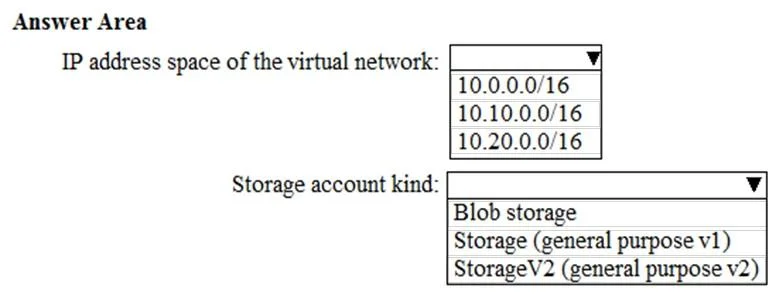
Answer Area
- IP address space of the virtual network:10.0.0.0/1610.10.0.0/1610.20.0.0/16
- Storage account kind:Blob storageStorage (general purpose v1)StorageV2 (general purpose v2)
Explanation
To support a hybrid cloud migration, the Azure VNet must use a non-overlapping IP address space, and a StorageV2 account is the recommended standard for replication storage.
Approach. 1. Select '10.20.0.0/16' for the IP address space. The on-premises offices use 10.0.0.0/16 (New York) and 10.10.0.0/16 (Los Angeles), and they connect to Azure via ExpressRoute. To ensure proper routing across the hybrid connection without conflicts, the Azure VNet must have a unique, non-overlapping IP space. 2. Select 'StorageV2 (general purpose v2)' for the storage account kind. General-purpose v2 is Microsoft's recommended storage account type for almost all workloads, including acting as cache or target storage for Azure Migrate and Azure Site Recovery. It supports the latest features, security protocols, and lifecycle management.
Common mistakes.
- common_mistake. Selecting 10.0.0.0/16 or 10.10.0.0/16 is a critical networking mistake because it creates an IP address overlap with the on-premises networks, which will break routing over the ExpressRoute/VPN connection. Choosing 'Blob storage' is incorrect because VM disk replication requires page blobs, typically managed within a general-purpose account. Choosing 'Storage (general purpose v1)' is incorrect because it is a legacy account type that Microsoft advises against using for new deployments.
Concept tested. Hybrid Network IP Address Planning and Azure Storage Account Types
Topics
Community Discussion
No community discussion yet for this question.