
AZ-104 · Question #229
Case Study 4 - ADatum Overview ADatum Corporation is a financial company that has two main offices in New York and Los Angeles. ADatum has a subsidiary named Fabrikam, Inc. that shares the Los…
Selecting the Standard App Service plan and the Always On feature ensures a production-grade, responsive environment for line-of-business applications.
Question
Exhibit
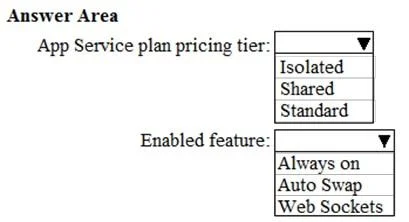
Answer Area
- App Service plan pricing tier:IsolatedSharedStandard
- Enabled feature:Always onAuto SwapWeb Sockets
Explanation
Selecting the Standard App Service plan and the Always On feature ensures a production-grade, responsive environment for line-of-business applications.
Approach. Based on the case study mentioning the deployment of 'new line-of-business applications', a robust and responsive environment is crucial.
-
App Service plan pricing tier: Standard The 'Standard' tier is chosen because it offers dedicated compute resources, autoscaling capabilities, custom domains, SSL support, and staging slots, making it highly suitable for production line-of-business applications that require reliable performance and scalability. It provides a good balance of features and cost-effectiveness compared to the more basic 'Shared' tier or the high-cost, highly isolated 'Isolated' tier.
-
Enabled feature: Always on The 'Always on' feature is selected because it prevents the web application from being unloaded due to inactivity. For line-of-business applications, it's critical to ensure quick response times and continuous availability, especially for background jobs, API endpoints, or webhooks that might not receive constant user traffic. Enabling 'Always on' ensures the application instance remains loaded and ready to respond without incurring cold starts.
Common mistakes.
- common_mistake. 1. Choosing 'Shared' for the pricing tier: The 'Shared' tier is not suitable for production 'line-of-business applications'. It runs on shared resources, lacks dedicated compute, and offers very limited features, making it prone to performance issues, unreliability, and not meeting typical production requirements.
- Choosing 'Isolated' for the pricing tier without specific requirements: While 'Isolated' offers the highest level of performance and network isolation (within an Azure Virtual Network), it is also the most expensive. Unless the application explicitly requires VNet integration for enhanced security, hybrid connectivity, or extreme scale beyond what 'Standard' or 'Premium' offers, 'Standard' is a more cost-effective and appropriate choice for general production LOB apps.
- Choosing 'Auto Swap' for the enabled feature instead of 'Always on': 'Auto Swap' is a deployment feature used with staging slots for automated, zero-downtime deployments. While beneficial for CI/CD, it doesn't address the fundamental need for the application itself to remain active and responsive, which 'Always on' provides.
- Choosing 'Web Sockets' for the enabled feature instead of 'Always on': 'Web Sockets' is a communication protocol feature for real-time applications. While important for specific architectures, it's not a general operational requirement for an application to stay active and responsive in the way 'Always on' is. 'Always on' ensures the app instance is loaded, irrespective of the communication protocols it uses.
Concept tested. Azure App Service plan pricing tiers and their associated features. This includes understanding the capabilities and limitations of different tiers (Shared, Standard, Isolated) and the purpose and availability of key operational features like 'Always On' for ensuring application responsiveness and reliability in production environments.
Topics
Community Discussion
No community discussion yet for this question.