
840-450 · Question #45
Drag and Drop Question Consider the four building blocks of the BMC that are directly linked to the customer segment. Drag and drop the four correct building blocks from the left to the right. Not…
The correct answer is Value proposition; Key partners; Key activities; Customer relationships. BMC Building Blocks Directly Linked to Customer Segments Important caveat upfront: The provided "correct" answer appears to contain errors based on standard BMC theory (Osterwalder & Pigneur). I'll explain the correct framework and flag the discrepancy so you can study…
Question
Drag and Drop Question Consider the four building blocks of the BMC that are directly linked to the customer segment. Drag and drop the four correct building blocks from the left to the right. Not all options are used. Answer:
Exhibit
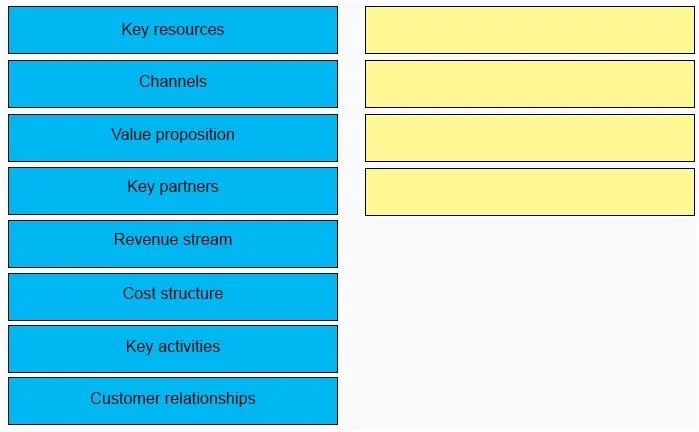
Answer Area
Drag items
Correct arrangement
- Value proposition
- Key partners
- Key activities
- Customer relationships
Explanation
BMC Building Blocks Directly Linked to Customer Segments
Important caveat upfront: The provided "correct" answer appears to contain errors based on standard BMC theory (Osterwalder & Pigneur). I'll explain the correct framework and flag the discrepancy so you can study accurately.
Standard BMC Theory
The Business Model Canvas divides into two sides:
| Right Side (Customer-Facing) | Left Side (Infrastructure) |
|---|---|
| Customer Segments | Key Resources |
| Value Propositions | Key Activities |
| Channels | Key Partners |
| Customer Relationships | Cost Structure |
| Revenue Streams |
The four building blocks directly linked to Customer Segments are the other four right-side blocks:
1. Value Proposition
Why directly linked: You design your VP for a specific customer segment. The relationship is definitional - without knowing who your segment is, you cannot define what value to offer. It's the core exchange: "We offer X to segment Y."
2. Channels
Why directly linked: Channels are how you reach and deliver value to your customer segments. Each segment may be reached through different channels. The link is direct: segment → how do we reach them?
3. Customer Relationships
Why directly linked: You define the type of relationship you establish with each segment (self-service, dedicated support, community, etc.). Segments determine relationship strategy directly.
4. Revenue Streams
Why directly linked: Revenue streams come from customer segments paying for your value proposition. Each segment may generate different revenue models (subscription vs. one-time, etc.).
What's Wrong with the Given Answer
| Given Answer | Correct per BMC? |
|---|---|
| Value Proposition | Yes - directly linked |
| **Key Partners ** | No - left-side block, linked to Key Activities/Resources |
| **Key Activities ** | No - left-side block, supports Value Proposition creation |
| Customer Relationships | Yes - directly linked |
Key Partners and Key Activities are indirectly linked to Customer Segments through the value chain:
Key Partners → Key Activities → Value Proposition → Customer Segments
They are not directly linked.
Common Misconceptions
- "Everything links to the customer" - True in a broad sense, but Key Activities and Key Partners are infrastructure blocks serving the left side of the canvas.
- Confusing Revenue Streams with Cost Structure - Revenue Streams are customer-facing (directly linked); Cost Structure is not.
- Forgetting Channels - Channels are easily overlooked but are one of the four direct links, since segments define which channels make sense.
Recommendation: If this is from a specific course or textbook, verify against their specific diagram. But by standard Osterwalder BMC theory, the correct four directly-linked blocks are Value Proposition, Channels, Customer Relationships, and Revenue Streams - not Key Partners or Key Activities.
Topics
Community Discussion
No community discussion yet for this question.