
840-450 · Question #25
Drag and Drop Question You are developing a customer journey map. Drag and drop each customer touch point on the left to the correct touch point type on the right. Answer:
The correct answer is Improve internal efficiencies of known customer interaction pain points; Maximize customer benefits instead of shareholder value; Are cost measures that improve the customer experience; Do not improve the customer experience; Are cost-cutting measures that negatively affect the customer experience; Maximize shareholder returns instead of customer benefits. Customer Journey Map Touch Point Classification This question tests your understanding of how customer touch points are classified based on their impact on customer experience versus business/shareholder priorities. The 6 items are split into two touch point types (3 items…
Question
Drag and Drop Question You are developing a customer journey map. Drag and drop each customer touch point on the left to the correct touch point type on the right. Answer:
Exhibit
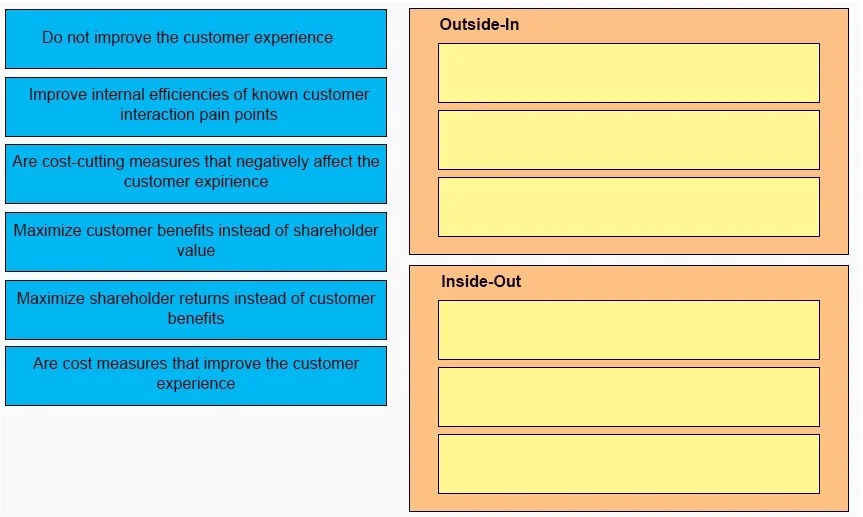
Answer Area
Drag items
Correct arrangement
- Improve internal efficiencies of known customer interaction pain points
- Maximize customer benefits instead of shareholder value
- Are cost measures that improve the customer experience
- Do not improve the customer experience
- Are cost-cutting measures that negatively affect the customer experience
- Maximize shareholder returns instead of customer benefits
Explanation
Customer Journey Map Touch Point Classification
This question tests your understanding of how customer touch points are classified based on their impact on customer experience versus business/shareholder priorities.
The 6 items are split into two touch point types (3 items each):
Type 1: Effective / Customer-Centric Touch Points (Positions 1–3)
These are touch points that should be prioritized because they genuinely benefit the customer.
| # | Item | Why it belongs here |
|---|---|---|
| 1 | Improve internal efficiencies of known customer interaction pain points | Fixing internal friction (e.g., slow processes, handoff errors) directly reduces customer frustration, even if the customer never sees the internal change. |
| 2 | Maximize customer benefits instead of shareholder value | This is the defining trait of a customer-centric touch point - decisions are made with the customer outcome as the primary goal. |
| 3 | Are cost measures that improve the customer experience | Cost reduction and good CX are not mutually exclusive. When cost initiatives also help customers (e.g., self-service portals that save money AND reduce wait times), they qualify as effective touch points. |
Type 2: Ineffective / Company-Centric Touch Points (Positions 4–6)
These are touch points that should be avoided or redesigned because they fail or harm the customer.
| # | Item | Why it belongs here |
|---|---|---|
| 4 | Do not improve the customer experience | A touch point that is neutral - neither helping nor hurting - is still a wasted opportunity. Ineffective by definition. |
| 5 | Are cost-cutting measures that negatively affect the customer experience | The classic failure mode: cost reduction at the customer's expense (e.g., removing live support to save money). |
| 6 | Maximize shareholder returns instead of customer benefits | When shareholder value drives touch point decisions, customer needs are deprioritized - the opposite of customer journey best practice. |
Common Misconceptions
- "Cost measures are always bad for customers" - Wrong. Item 3 shows cost initiatives can improve CX. The key distinction is the outcome, not the motivation.
- Confusing items 3 and 5 - These are mirror opposites. Item 3 = costs down + CX up. Item 5 = costs down + CX down. The customer outcome is what separates them.
- Thinking "neutral" is acceptable - Item 4 (does not improve CX) is still classified as ineffective. Customer journey mapping demands every touch point add value; neutral is not good enough.
- Conflating items 2 and 6 - They are direct opposites: customer benefits vs. shareholder returns. These test whether you understand the customer-first philosophy that underpins journey mapping.
Topics
Community Discussion
No community discussion yet for this question.