
840-450 · Question #44
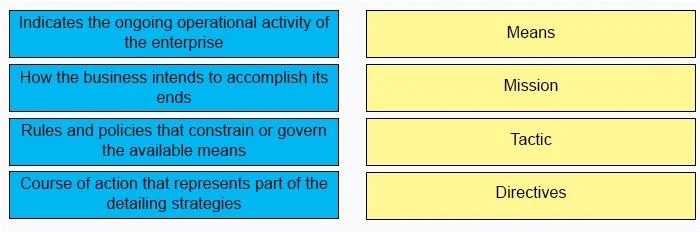
Drag and Drop Question Drag and drop each description on the left to the appropriate business motivational model on the right. Answer:
The correct answer is Rules and policies that constrain or govern the available means; How the business intends to accomplish its ends; Course of action that represents part of the detailing strategies; Indicates the ongoing operational activity of the enterprise. Business Motivation Model (BMM) - Drag & Drop Explanation This question maps descriptions to the four core Means components of the OMG Business Motivation Model (BMM). The right-side targets are: Directive, Strategy, Tactic, and Mission. --- The Correct Mapping | Position |…
Question
Drag and Drop Question Drag and drop each description on the left to the appropriate business motivational model on the right. Answer:
Exhibit
Answer Area
Drag items
Correct arrangement
- Rules and policies that constrain or govern the available means
- How the business intends to accomplish its ends
- Course of action that represents part of the detailing strategies
- Indicates the ongoing operational activity of the enterprise
Explanation
Business Motivation Model (BMM) - Drag & Drop Explanation
This question maps descriptions to the four core Means components of the OMG Business Motivation Model (BMM). The right-side targets are: Directive, Strategy, Tactic, and Mission.
The Correct Mapping
| Position | Target (Right Side) | Description (Left Side) |
|---|---|---|
| 1 | Directive | Rules and policies that constrain or govern the available means |
| 2 | Strategy | How the business intends to accomplish its ends |
| 3 | Tactic | Course of action that represents part of the detailing strategies |
| 4 | Mission | Indicates the ongoing operational activity of the enterprise |
Why Each Placement is Correct
1. Directive ← "Rules and policies that constrain or govern the available means" Directives are the governing layer - they don't do anything themselves but shape what Strategies and Tactics are permissible. They split into Business Policies (non-enforceable guidance) and Business Rules (specific, enforceable constraints). "Constrain or govern the means" is the textbook definition.
2. Strategy ← "How the business intends to accomplish its ends" In BMM, Ends are what you want (Goals, Objectives), and Means are how you achieve them. A Strategy is the high-level approach linking the two - it answers "how will we get there?" without prescribing step-by-step actions.
3. Tactic ← "Course of action that represents part of the detailing strategies" Tactics are subordinate to Strategies. They break a strategy into concrete, actionable courses of action. The phrase "detailing strategies" is a direct signal - Tactics exist because of Strategies and make them operational.
4. Mission ← "Indicates the ongoing operational activity of the enterprise" Mission is the day-to-day definition of what the enterprise does - its continuous operational purpose. It's not a one-time goal; it's persistent. This distinguishes it from Vision (aspirational future state).
Common Mistakes
- Confusing Mission with Vision: Vision is aspirational ("what we want to become"); Mission is operational ("what we do every day"). The word ongoing is the key discriminator.
- Swapping Strategy and Tactic: Both are action-oriented, but Tactics detail Strategies - they're one level below. If you see "detailing" or "part of," it's a Tactic.
- Missing that Directive covers both rules AND policies: Students often only think of Business Rules. Directives are the umbrella term.
Topics
Community Discussion
No community discussion yet for this question.