
352-001 · Question #90
Refer to the exhibit. You are designing an IPv4 unicast Layer 3 VPN load-balancing solution. Which L3VPN feature needs to be configured on the PE routers to support the design requirement?
The correct answer is A. nonmatching route distinguishers. In L3VPN, load balancing across multiple PE routers requires BGP to maintain multiple equal-cost paths to the same customer destination. By default, if two PE routers advertise the same customer prefix using identical RDs, BGP sees them as the same VPNv4 route and selects only…
Question
Refer to the exhibit. You are designing an IPv4 unicast Layer 3 VPN load-balancing solution. Which L3VPN feature needs to be configured on the PE routers to support the design requirement?
Exhibit
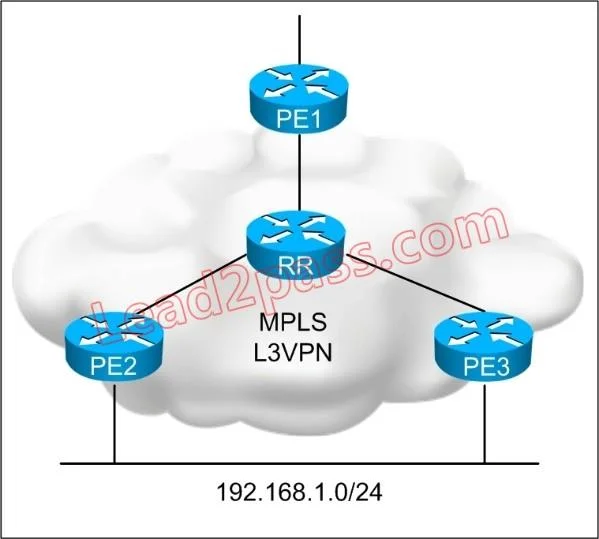
Options
- Anonmatching route distinguishers
- Bmatching route target values
- Cdisable split horizon on PE2 and PE3
- Dmatching route distinguishers
How the community answered
(26 responses)- A54% (14)
- B8% (2)
- C15% (4)
- D23% (6)
Explanation
In L3VPN, load balancing across multiple PE routers requires BGP to maintain multiple equal-cost paths to the same customer destination. By default, if two PE routers advertise the same customer prefix using identical RDs, BGP sees them as the same VPNv4 route and selects only a single best path - eliminating load balancing. The solution is to configure nonmatching (different) RDs on each PE for the same VRF. This causes the same customer IPv4 prefix to appear as distinct VPNv4 routes in BGP (e.g., 1:1:10.0.0.0/24 vs 2:2:10.0.0.0/24). BGP can then retain and use multiple paths simultaneously, enabling load balancing. Matching RTs (choice B) are necessary for route import/export between VRFs but do not themselves enable load balancing. Matching RDs (choice D) would have the opposite effect - collapsing paths into a single BGP route. Split horizon (choice C) is not relevant to this L3VPN load-balancing design.
Topics
Community Discussion
No community discussion yet for this question.